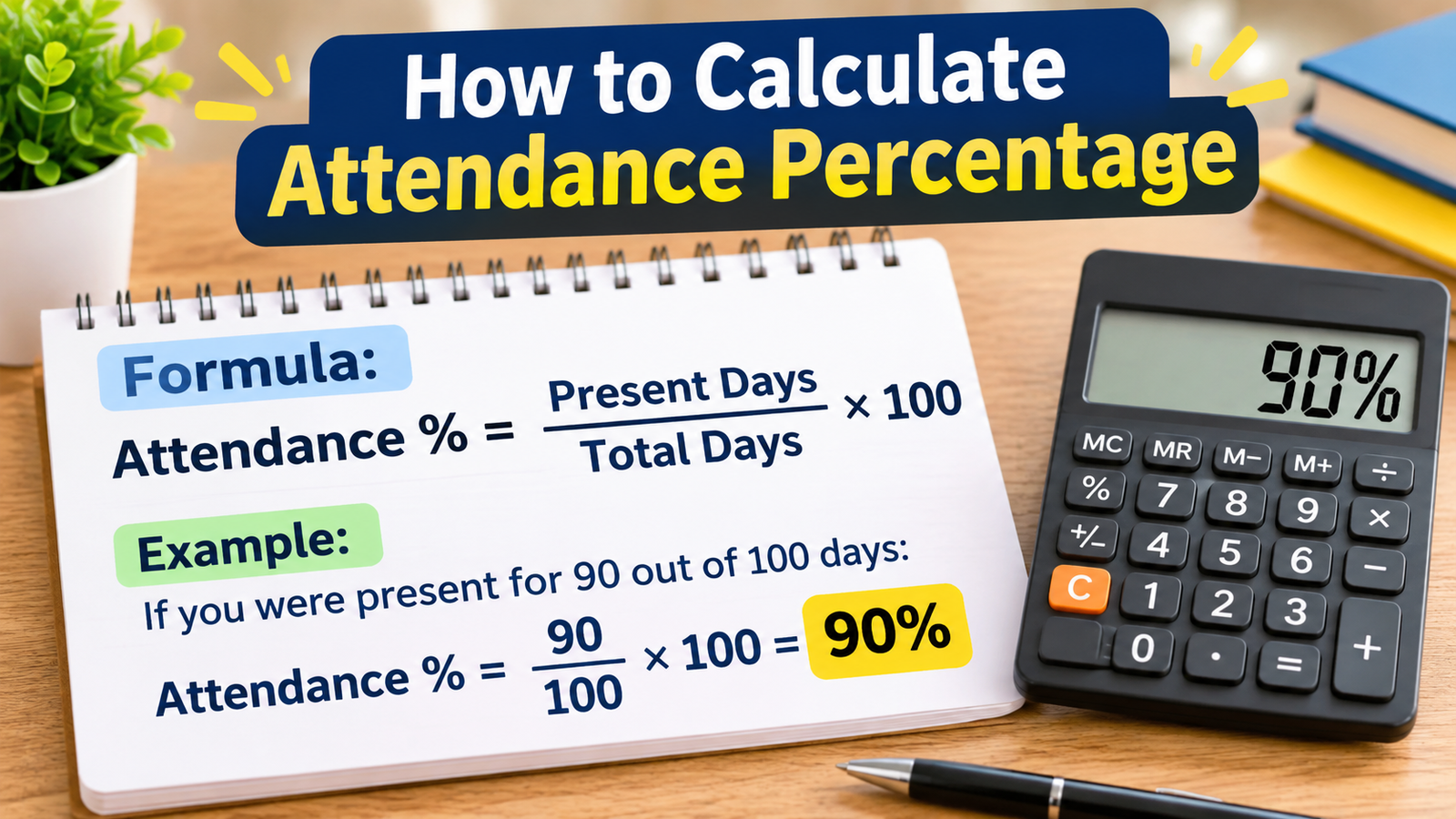
Short answer: divide the number of classes you attended by the total number of classes held, then multiply by 100. That’s your attendance percentage. The formula takes ten seconds, but the real questions usually come after it: Am I above the minimum? How many classes can I still miss? How many do I need to attend to get back on track?
This guide covers all of it, with simple examples you can follow on paper, in Excel, or with a calculator.
The Attendance Percentage Formula
Attendance % = (Classes attended ÷ Total classes held) × 100
Total classes held means the classes that actually took place so far, not the full number planned for the whole semester. If a lecture was cancelled, it doesn’t count toward the total.
Example: You attended 34 classes out of 40 held. Divide 34 by 40 to get 0.85, then multiply by 100. Your attendance is 85%.
Quick Reference Examples
| Classes Attended | Total Classes Held | Attendance % |
| 18 | 20 | 90% |
| 34 | 40 | 85% |
| 30 | 40 | 75% |
| 51 | 60 | 85% |
| 27 | 45 | 60% |
How to Calculate It Step by Step
- Count the classes held. Check your attendance sheet or register for the total number of sessions so far.
- Count the classes you attended. Include only the days you were marked present.
- Divide attended by total. This gives you a decimal.
- Multiply by 100. Now you have your percentage.
What If You Have Excused Absences or Late Arrivals?
This depends entirely on your school’s policy, so read the attendance rules in your handbook or syllabus. Common approaches include:
- Excused absences: Some schools count them as present, so you’d use (attended + excused) ÷ total. Others remove them from the total instead.
- Late arrivals: Some schools count a late arrival as half a class, and others as a full absence after a set number of minutes.
- Medical leave: Many institutions accept a certificate and adjust the record, but you often need to submit it within a deadline.
How Many Classes Can You Miss?
Many colleges and universities require a minimum attendance, commonly 75% or 80%, though the exact number varies. To find how many classes you can miss, use this:
Maximum absences = Total classes × (1 − required %)
Example: Your course has 80 classes in total and requires 75% attendance. That gives 80 × 0.25 = 20 classes you can miss for the whole term. Every absence you’ve already taken comes out of that number.
How Many Classes Do You Need to Attend to Reach 75%?
If your attendance has dropped below the limit, you can work out how many consecutive classes you must attend to recover. Use this:
Classes needed = (0.75 × Total − Attended) ÷ 0.25
Example: You’ve attended 30 out of 45 classes, which is about 66.7%. Classes needed = (0.75 × 45 − 30) ÷ 0.25 = 3.75 ÷ 0.25 = 15. After 15 more classes with perfect attendance, you’ll have attended 45 of 60, which is exactly 75%.
For an 80% requirement, replace 0.75 with 0.80 and 0.25 with 0.20.
Calculate Attendance Percentage in Excel or Google Sheets
If you keep a daily log, a spreadsheet does the work for you. Mark each day with “P” for present or “A” for absent in column B, then use:
=COUNTIF(B2:B50,”P”)/COUNTA(B2:B50)
Format the cell as a percentage and you’ll see your attendance update automatically each time you add a new day.
Why Attendance Matters for Your Grades
Attendance often counts directly toward your final mark. Some courses give 5% or 10% of the grade for it, and a few instructors lower grades for too many absences. Even when it isn’t graded, students who attend regularly tend to understand the material better and score higher on exams. If attendance is part of your course grade, you can include it in your total with the Easy Graders calculator and see exactly where you stand.
It also feeds into your overall average. Once you know your final course grades, you can enter them into the GPA calculator to see how the semester affects your GPA.
Tracking Attendance as an Online Student
Online programs usually track participation through logins, discussion posts, and assignment submissions rather than a roll call. Check how your course defines attendance so you don’t lose points without realizing it. If you study at Grand Canyon University, the GCU Portal page gathers the student, faculty, and parent login links in one place, so you can get to your course area quickly.
Tips to Keep Your Attendance Healthy
- Treat the minimum as a ceiling for absences, not a goal. Keep a buffer for emergencies and illness.
- Check your percentage every few weeks instead of waiting until the end of the term.
- Talk to your instructor early if you expect a long absence, and ask what paperwork they need.
- Keep copies of medical certificates and approved leave letters.
- Save your full-attendance days for exam weeks, since missed classes then hurt the most.
Frequently Asked Questions
How do you calculate attendance percentage?
Divide the classes you attended by the total classes held, then multiply by 100.
What is the formula for attendance percentage?
Attendance % = (Classes attended ÷ Total classes) × 100.
How many classes can I miss with 75% attendance?
You can miss up to 25% of the total classes. In a course with 80 classes, that’s 20 absences.
Is 75% attendance enough?
It depends on your institution. Many require 75%, others 80% or 85%, and some accept less with approved leave. Always check your own policy.
How do I calculate attendance percentage for a month?
Count the working or class days in the month as the total, count the days you were present, then use the same formula.
Do excused absences count as attendance?
That varies by school. Some count them as present, others remove them from the total, so confirm in your handbook.
Final Thoughts
Calculating attendance percentage is simple once you know the formula: attended divided by total, times 100. The useful part is using it early, before a shortage becomes a problem. Know your required minimum, work out how many absences you have left, and check your number regularly so there are no surprises at the end of the term.