If you’ve ever stared at a transcript and wondered what a 3.4 actually means, you’re not alone. The GPA system in America looks simple on the surface, but it comes with its own scales, rules, and quirks. This is especially true if you’re an international student, a parent helping a teenager, or a college freshman seeing a GPA for the first time.
This guide walks through how the American GPA system works, how to calculate your own, and what the number means for your future.
What Is GPA in the American Education System?
GPA stands for Grade Point Average. It’s a single number that sums up your academic performance across all your classes. Instead of looking at every grade separately, schools, colleges, and employers use your GPA as a quick snapshot of how you’re doing.
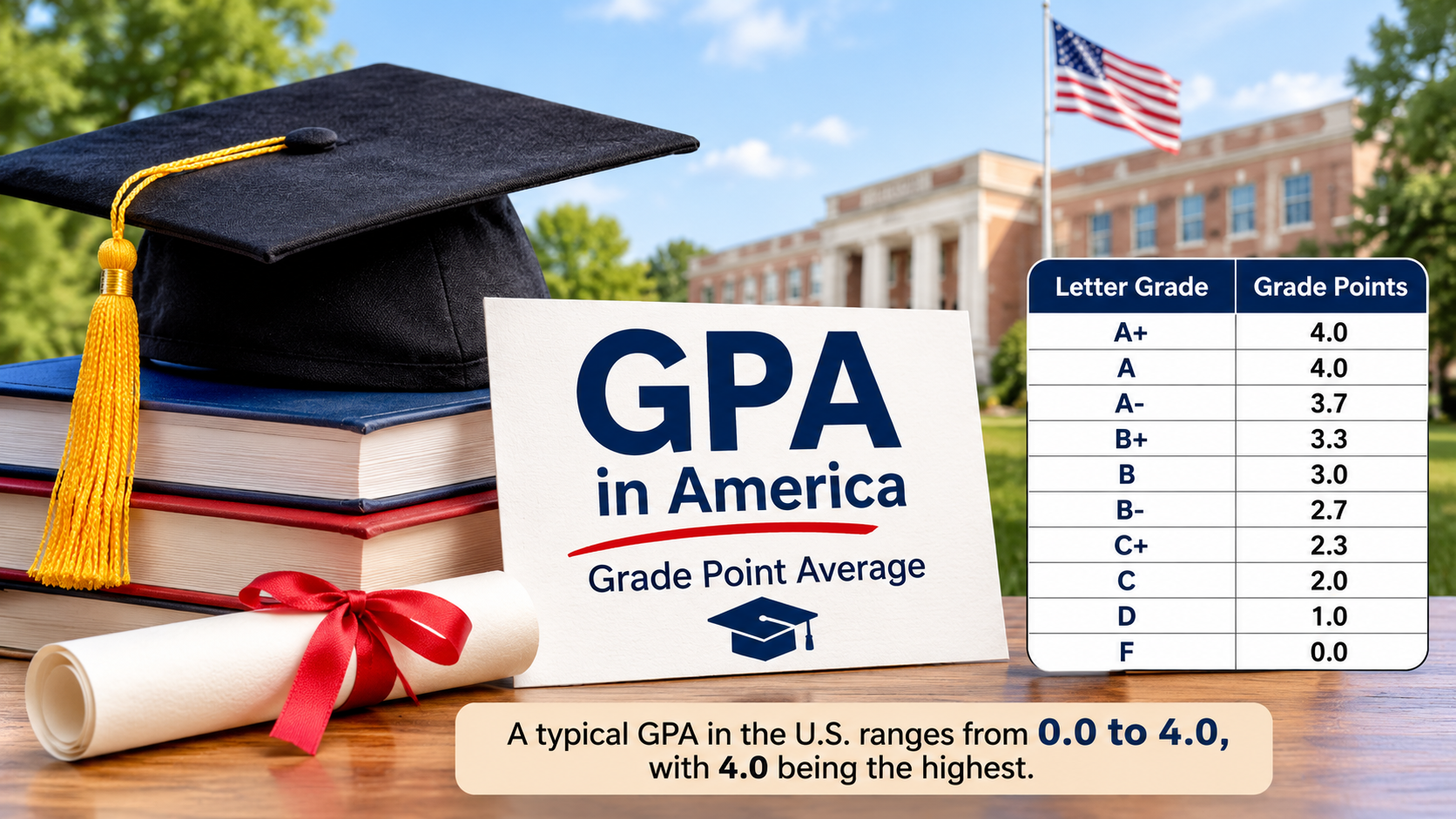
In the United States, most schools use a 4.0 scale. A 4.0 is the top score, equal to straight A’s. Anything lower shows how far your grades sit from that mark.
Your GPA matters for more than bragging rights. It can affect:
- College admissions
- Scholarships and financial aid
- Honors programs and academic awards
- Eligibility for sports and clubs
- Graduate school applications
- Some internships and first jobs
The Standard 4.0 GPA Scale
Here’s how letter grades usually convert to grade points in American schools:
| Letter Grade | Percentage (typical) | GPA Points |
| A+ / A | 93–100% | 4.0 |
| A- | 90–92% | 3.7 |
| B+ | 87–89% | 3.3 |
| B | 83–86% | 3.0 |
| B- | 80–82% | 2.7 |
| C+ | 77–79% | 2.3 |
| C | 73–76% | 2.0 |
| C- | 70–72% | 1.7 |
| D+ | 67–69% | 1.3 |
| D | 63–66% | 1.0 |
| D- | 60–62% | 0.7 |
| F | Below 60% | 0.0 |
One thing worth knowing: there is no single national grading standard in the US. Each school or district sets its own percentage cutoffs. Some schools don’t use plus and minus grades at all, and some treat an A+ as 4.3. Always check your school’s grading policy before assuming the table above applies to you.
Unweighted vs. Weighted GPA
This is where many students get confused, so let’s clear it up.
Unweighted GPA treats every class equally. An A in regular algebra and an A in AP Calculus are both worth 4.0. The maximum is always 4.0.
Weighted GPA gives extra credit for harder classes. Honors courses often add 0.5 points, while AP, IB, and dual-enrollment classes commonly add a full 1.0. That means an A in an AP class can count as a 5.0, and a weighted GPA can go above 4.0.
Why does this exist? Schools want to reward students who challenge themselves. A student who earns a B in AP Chemistry shouldn’t look worse on paper than someone who coasts through easy classes with an A.
Many colleges look at both numbers. They’ll often recalculate your GPA using their own method, so don’t be surprised if the number on your application differs from the one on your report card.
How to Calculate GPA (With a Real Example)
The formula is straightforward:
GPA = Total grade points ÷ Total credit hours
Each course’s grade points are the GPA value of your grade multiplied by the course’s credit hours. Here’s a sample semester:
| Course | Credits | Grade | Points | Credits × Points |
| English | 3 | A | 4.0 | 12.0 |
| Math | 4 | B+ | 3.3 | 13.2 |
| Biology | 3 | B | 3.0 | 9.0 |
| History | 3 | A- | 3.7 | 11.1 |
| PE | 1 | A | 4.0 | 4.0 |
| Total | 14 | 49.3 |
Divide 49.3 by 14 and you get a semester GPA of about 3.52.
Doing this by hand is fine once or twice, but it gets old quickly, especially when you’re juggling many classes or testing “what if I get a B instead of an A?” scenarios. A free tool like the GPA calculator on Easy Graders lets you enter your courses and credits and get the result instantly. It also supports 4.0, 4.3, and 5.0 scales, so it works whichever system your school follows.
Semester GPA vs. Cumulative GPA
You’ll see both terms often, and they mean different things.
- Semester (or term) GPA covers only the classes you took in one term.
- Cumulative GPA averages every grade from every term, from your first day to now.
Cumulative GPA is the one that usually appears on transcripts and applications. Because it covers everything, it moves slowly. A single bad semester in your first year hurts less once you’ve built up a lot of credits, and it’s harder to raise a low GPA late in the game. That’s why a strong start is so valuable.
What Counts as a “Good” GPA?
It depends on your goals, but here’s a general guide:
- 7–4.0: Excellent. Competitive for top universities and major scholarships.
- 0–3.6: Solid. Opens doors at most colleges and universities.
- 5–2.9: Average. Acceptable for many schools, but scholarship options narrow.
- 0–2.4: Passing, but you may face academic probation at some colleges.
- Below 2.0: Many schools require you to improve it to stay enrolled.
Most universities need students to keep a minimum cumulative GPA, often 2.0, to stay in good standing. Financial aid programs usually carry their own GPA requirements as well.
Do Colleges Really Care About GPA?
Yes, and often more than students realize. For most admissions offices, your GPA and the difficulty of your courses are among the most important parts of your application. Test scores, essays, and activities matter, but a steady record of strong grades shows you can handle the workload.
That said, GPA isn’t everything. Admissions officers also look at the trend. A student who started with a 2.8 and climbed to a 3.8 tells a better story than someone who slid the other way.
How GPA Works in College
College GPA follows the same 4.0 logic, but a few things feel different:
- Courses are measured in credit hours, usually 3 or 4 per class.
- Your portal is where you’ll check grades, track progress, and view your transcript. If you attend Grand Canyon University, for example, you can find the student, faculty, and parent access links on the GCU Portal page.
- Many schools have Dean’s List (often around 3.5 or higher in a term) and Latin honors like cum laude, magna cum laude, and summa cum laude at graduation.
- Some schools allow you to retake a class and replace the old grade. Policies differ, so check before you assume it’ll work.
GPA for International Students
If you’re coming to the US from another country, your home grades usually need to be converted to the 4.0 scale. Many universities ask for an official evaluation from a service like WES or ECE. Be careful with unofficial online converters, since different schools treat the same grade very differently. Use them for a rough estimate and rely on the official evaluation when it counts.
Practical Tips to Raise Your GPA
- Know the math. Understanding how credits weight your grades helps you decide where to focus your effort. A 4-credit class moves your GPA more than a 1-credit class.
- Track it during the term, not after. Check your standing at midterm so you can still act on it.
- Retake strategically. If your school allows grade replacement, retaking a D or F can make a real difference.
- Balance your schedule. Taking too many hard courses at once is a quick way to tank your average.
- Ask for help early. Tutoring, office hours, and study groups work far better before a grade slips than after.
- Run the numbers. Plug your expected grades into the Easy Graders calculator to see exactly what you need on your next exam to reach your target.
Frequently Asked Questions
What is the GPA system in America?
It’s a method of converting letter grades into numbers, usually on a 4.0 scale, and averaging them to show overall academic performance.
Is a 4.0 the highest GPA in the US?
On the unweighted scale, yes. On weighted scales, a GPA can reach 5.0 or higher because of honors, AP, or IB classes.
What is a 3.0 GPA?
It’s equal to a B average. It’s a respectable GPA and meets the requirement for many scholarships and programs.
Do all American schools use the same GPA scale?
No. The 4.0 scale is the most common, but individual schools set their own rules for plus and minus grades, weighting, and percentage cutoffs.
What is the difference between GPA and CGPA?
GPA usually refers to one term or school year, while CGPA (cumulative GPA) averages all of your terms together.
Can I raise my GPA after a bad semester?
Yes, though the effect depends on how many credits you’ve already earned. Consistent strong grades over the next few terms will lift it steadily.
Final Thoughts
The GPA system in America isn’t as complicated as it first looks. Once you understand the 4.0 scale, how credit hours work, and the difference between weighted and unweighted grades, the number on your transcript starts to make sense. It’s also not a verdict on your worth or intelligence. It’s a tool, and one you can improve with good planning.
Keep your own numbers in view, check your progress often, and use a reliable calculator to plan ahead. A few minutes of tracking each semester can save you a lot of stress later.