If you have a cumulative exam coming up, the first thing you probably want to know is simple: how many questions will actually be on it? Unfortunately, there’s no single fixed number. A cumulative exam can have anywhere from 20 to well over 100 questions, depending on the course, the grade level, and how much material it’s covering. But once you understand what shapes that number, you can prepare for it far more confidently.
In this article, we’ll explain what a cumulative exam actually is, what determines how many questions it contains, how it differs from a regular test, and how tools like an online grading calculator can help you understand exactly how each question affects your final score.
What Is a Cumulative Exam?
A cumulative exam is a test that covers everything you’ve learned over an entire course, semester, or academic year, not just the most recent chapter or unit. Unlike a regular quiz or unit test, which focuses on a small, recent portion of material, a cumulative exam pulls questions from the very beginning of the term all the way to the present.
Cumulative exams are common in:
- Final exams at the end of a semester
- Midterms that combine several earlier units
- Standardized tests and certification exams
- Comprehensive finals in college courses
Because they cover so much ground, cumulative exams are usually longer and more detailed than a typical test, which is exactly why the number of questions varies so much from class to class.
What Determines the Number of Questions on a Cumulative Exam?
There’s no universal rule for how many questions a cumulative exam must have. Instead, the number depends on several factors:
- Course length and content: A semester-long course with 15 chapters will naturally need more questions to cover everything than a shorter, 6-week course.
- Question format: A 50-question multiple-choice exam might cover the same material as a 5-question essay exam. Format changes the count dramatically.
- Time allotted for the exam: Teachers design exams to fit within a class period or testing window, so the number of questions is often built around available time, not just content coverage.
- Grade level and subject: Math and science cumulative exams often rely on problem-solving questions, so they may have fewer, longer questions. Humanities exams may include more short-answer or multiple-choice items.
- Instructor’s grading style: Some teachers prefer many small questions for a granular score, while others prefer fewer, weighted questions worth more points each.
Because of these variables, a general rule of thumb is that most cumulative final exams range between 40 and 100 questions, especially for standardized, multiple-choice-style tests, but this can be much lower for exams built around essays or long-form problems.
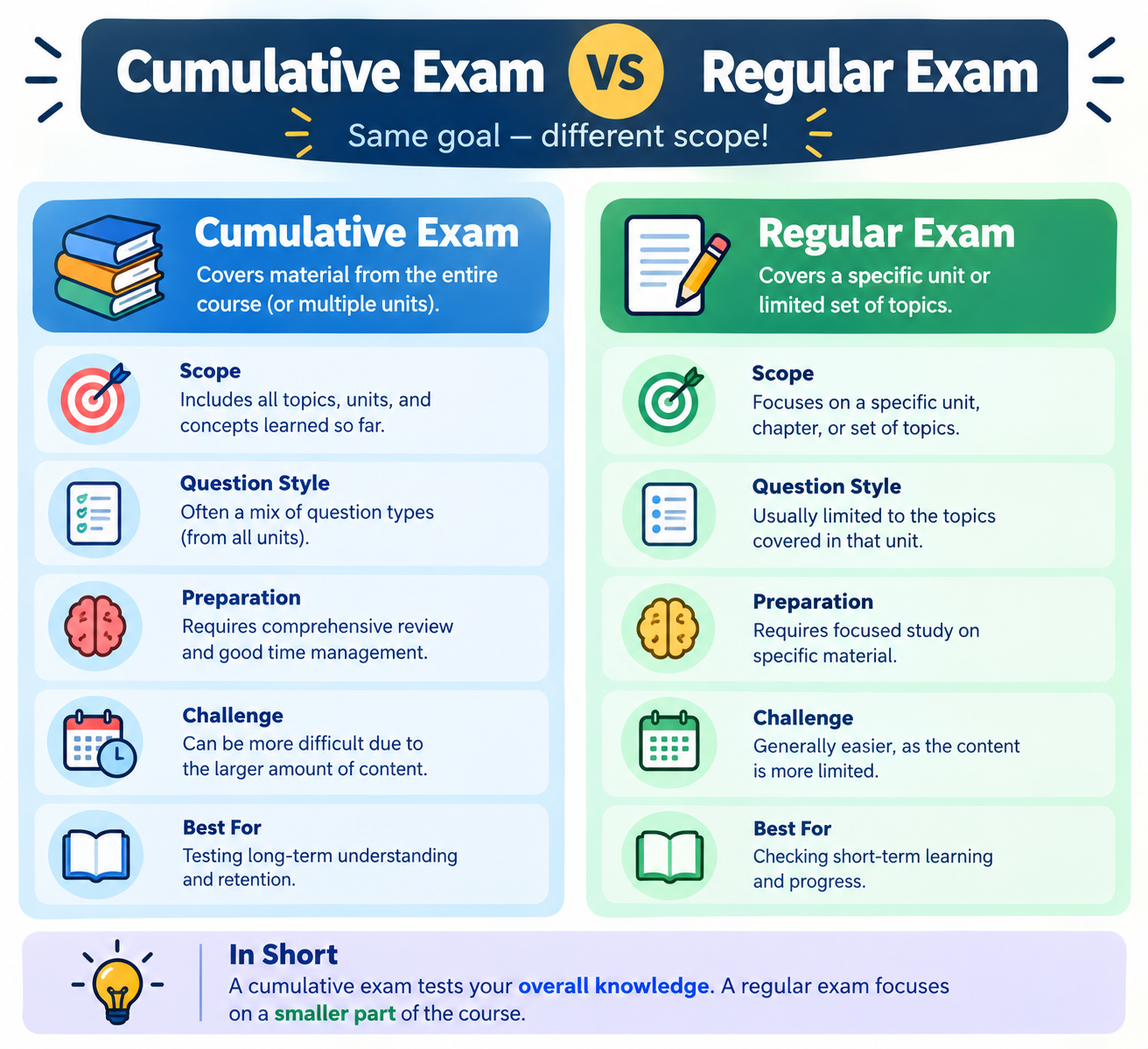
Cumulative Exam vs. Regular Exam: What’s the Difference?
| Feature | Regular Exam | Cumulative Exam |
|---|---|---|
| Material covered | One unit or chapter | Entire course or semester |
| Number of questions | Usually fewer | Usually more |
| Preparation time needed | Shorter, focused study | Longer, spread-out review |
| Weight in final grade | Often smaller | Often larger |
Because a cumulative exam typically carries more weight toward your final grade, understanding how each question is scored, and how bonus points or partial credit factor in, becomes especially important. If your instructor includes an extra question worth a few points, it’s worth knowing how bonus questions in exams actually affect your overall percentage, since they can push your score above the total number of required points.
How Question Count Affects Your Score
The number of questions on a cumulative exam directly affects how much each individual question is worth. For example:
- On a 50-question exam, each question is typically worth 2% of your total grade.
- On a 100-question exam, each question is worth only 1%.
- On a 20-question exam, a single mistake could cost you 5% or more.
This is why it helps to know the question count before you sit down for the exam. It changes how carefully you should approach each question and how much a single wrong answer can hurt your final grade.
If you want to quickly figure out what your score would be based on how many questions you got right, an easy grader tool can instantly calculate your percentage once you know the total number of questions and how many you answered correctly, without needing to do the math by hand.
How to Prepare for a Cumulative Exam With Many Questions
Because cumulative exams cover so much material, preparation looks different from studying for a single-unit test. A few practical tips:
- Start early: Don’t wait until the night before. Review notes, quizzes, and past tests from the entire course, not just recent material.
- Make a topic checklist: Break the course down into units or chapters and review each one systematically, so nothing gets skipped.
- Practice with old exams or quizzes: If your instructor reuses question styles, past tests are one of the best predictors of what’s coming.
- Avoid last-minute cramming: Cramming for a test might work for a small quiz, but with a large cumulative exam, it usually leads to weaker recall under pressure.
- Know the format in advance: Ask your instructor whether the exam will be multiple-choice, short answer, essay-based, or a mix, so you can adjust your study strategy accordingly.
If you’re hoping to walk in with minimal prep and still do well, it’s worth reading up on realistic expectations around passing a test without studying, since cumulative exams are usually too broad in scope for that approach to reliably work.
Estimating Your Grade Before the Exam Is Graded
Once you’ve finished a cumulative exam, you don’t always have to wait for your instructor to hand back results to get a sense of how you did. If you know roughly how many questions you answered correctly out of the total, a grading chart can help you translate that raw score into a letter grade instantly, so you know where you stand on the A-F scale.
This is especially useful for students trying to calculate their overall GPA, since a single cumulative final can significantly shift a semester grade. Many students pair this kind of quick calculation with their school’s official grade records, similar to checking a GCU student portal, to confirm everything lines up once the instructor posts final scores. And if you’re tracking your semester average across multiple cumulative exams, a GPA calculator makes it easy to see how one big test affects your overall standing.
Final Thoughts
There’s no fixed answer to “how many questions are on a cumulative exam.” It depends on the course, the format, and how the instructor chooses to structure it. What’s consistent, though, is that cumulative exams cover more material, carry more weight, and reward students who prepare steadily rather than cramming at the last minute.
Whether your exam has 30 questions or 130, understanding how each one contributes to your final percentage, and using tools like an easy grader or grading chart to check your score, can take a lot of the guesswork out of exam day.