
There are two very different situations that bring someone to this question. The first is a student who has been paying attention in class, doing the work, and simply has no time left to do a formal study session before tomorrow. The second is a student who has not engaged with the material at all and is looking for a way through.
Both situations are real, both are common, and both require a different approach. What they share is this: formal studying is off the table, and something else has to take its place. This article covers what that something else looks like, what actually helps when preparation time has run out, and how to think through a test strategically when you are walking in without a full review behind you.
What Passing a Test Without Studying Actually Requires
The title of this article is a little misleading, so it is worth being direct about something upfront. There is no reliable method that lets you completely bypass preparation and still perform well consistently. What does exist are strategies that let you perform significantly better than you otherwise would, given that traditional studying is not happening.
Those strategies fall into two categories. The first covers what you can do in the time you have left, even if that time is less than an hour. The second covers how to perform better inside the test itself, using how tests are structured to your advantage. Both categories matter and both are covered here.
Understanding what you already know
Most students underestimate how much they have retained from class without intentionally studying. If you have attended most classes, done at least some of the assigned reading, and completed homework, there is more in your memory than it feels like right now. The goal in the short time you have is not to build new knowledge but to make what is already there more accessible under test conditions.
This is also why knowing your current standing matters going in. A student at a 16/20 grade who needs to protect their average is working with a different priority than someone starting from a 12/20 grade who needs a strong result to change their trajectory. The grade scale tells you exactly what score you need from tomorrow’s test before you decide how to approach it.
What to Do in the Time You Have Left
If you have one hour or less
Do not try to cover everything. That instinct is what makes one-hour prep sessions so ineffective. Pick the three topics most likely to appear on the test based on what your teacher emphasized in class, what appeared on previous quizzes, and what the study guide or syllabus listed as priorities.
For each of those three topics, spend 15 minutes doing one thing only. Write down everything you can remember about it from scratch, without looking at notes. What you can produce is solid. What you cannot produce is what you review for the remaining 5 minutes of that slot. Then move to the next topic. Cover your three priorities and stop.
If you have 20 minutes or less
At this point the strategy shifts entirely. Do not open your notes at all. Instead, think through the test format. If it is multiple choice, your preparation is mental, not material. Remind yourself of how elimination works and how to approach questions where two answers look similar. If it is an essay, decide right now what your main point would be on each likely topic so you are not constructing your argument in real time during the test, which wastes minutes you cannot afford.
If there are formulas, dates, or definitions you know you need, write those on a piece of paper right now from memory. What you can write is what you have. What you cannot write is what you probably would not have retrieved reliably under test conditions anyway.
If you have no time at all
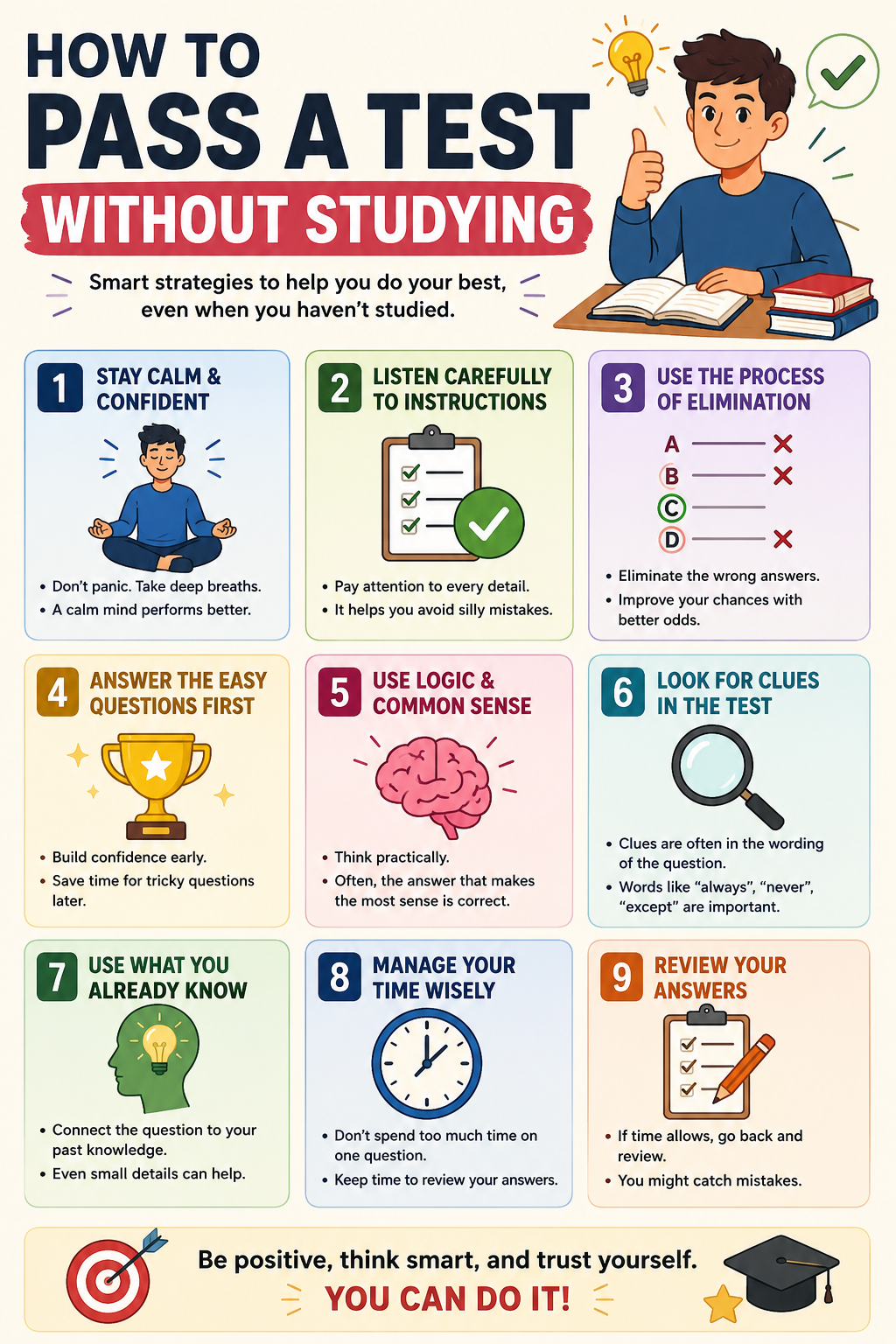
Walk in calm. This is not sarcasm. Anxiety under test conditions produces worse performance than the missing preparation does. Students who panic make avoidable mistakes on questions they actually know. Students who stay composed and work methodically through what they have tend to outperform their apparent level of preparation.
Smart Test-Taking Strategies That Work Without Prior Review
Read every question fully before answering anything
Students who are underprepared often rush into answers because they feel time pressure. This produces mistakes on questions they could have answered correctly with a careful read. Read the full question before looking at the options. The question itself often contains language that triggers recall of relevant material you did not know you remembered.
Reading all questions first also helps you spot questions that answer each other. On a 20 or 25 question test it is common for a detail mentioned in one question to confirm or eliminate an answer in another. You only catch that if you have read through before committing to answers.
Do the easy questions first
Go through the entire test and answer every question you know with confidence before touching anything uncertain. This does two things. It accumulates points without any risk of getting bogged down, and it creates a psychological momentum that makes the harder questions feel more manageable. Students who start with the hardest question and spend ten minutes on it before moving on often run out of time on questions they would have answered correctly.
On a test where each question carries significant weight, getting the easy ones locked in first is especially important. A 22/25 grade versus a 19/20 grade often comes down to whether a student answered the questions they knew before getting stuck on the ones they did not.
Use process of elimination on every uncertain question
On multiple choice questions, wrong answers are often easier to identify than right ones. Go through the options and cross out anything that is clearly incorrect, contradicts basic logic, or uses language that does not match the question. If you eliminate two options, you have gone from a 25% to a 50% chance on a guess. If you eliminate three, you know the answer.
Two specific patterns help when you are guessing. If two options say essentially the same thing in different words, both are wrong because only one answer can be correct. If one option is significantly more specific than the others, it is more likely to be correct because test makers tend to write correct answers with precision.
Write something for every question you cannot answer
Leaving a question blank guarantees zero. Writing something that demonstrates partial understanding or a reasonable attempt at the answer earns partial credit on most short answer and essay tests. Even if you genuinely do not know the answer to a question, you can often identify what category the question belongs to, write a sentence establishing that context, and attempt an explanation from there.
For essay questions specifically, structure matters almost as much as content when you are underprepared. A clearly organized response with an introduction, a few organized points, and a conclusion demonstrates competence in academic writing even if the specific content is thin. Teachers grade these responses more generously than they grade disorganized responses that show the same level of knowledge.
How Class Attendance Changes What Is Possible
Students who attended most classes are in a meaningfully better position than students who did not, even if neither group studied. Sitting in a class where a teacher explains material, answers questions, and signals what is important creates passive retention that feels invisible until a test question triggers it.
If you attended class regularly, trust that more is in your memory than it feels like right now. The uncomfortable sensation before a test of not knowing what you know is normal and does not accurately predict your performance. Students consistently underestimate what they retained from class and overestimate how much formal studying would have changed the result.
How to use class notes even with no time to review them
If you have class notes and no time to read through them, take five minutes to scan just the headings, underlined words, and anything that was written on the board or repeated more than once. These are the signals your teacher used to mark importance during class. They are the most likely to show up on the test. Do not read full paragraphs. Scan for structure and repeated terms only.
Managing Your Mindset When You Are Not Prepared
The biggest performance gap between prepared and unprepared students is not knowledge. It is composure. A student who feels calm and works methodically through a test extracts significantly more from whatever preparation they have than a student who panics, second-guesses correct answers, and rushes through sections they could have done well on.
Three things help with this. First, accept before walking in that you will not know some answers and that is already priced in. You are not discovering this mid-test. Second, keep your eyes on your own paper in a different sense: do not let other students finishing early or flipping pages trigger anxiety about your own pace. Third, if you feel stuck on a question, skip it and come back. Spending four minutes on one uncertain question is almost always the wrong call.
The one thing to do the morning of the test
Eat something. This is not a wellness tip. Glucose availability has a direct effect on working memory and cognitive retrieval. Students who skip breakfast before a test perform measurably worse on questions requiring recall than students who ate. You cannot study at this point, but you can give your brain the fuel it needs to retrieve what is already there. If you want to understand what score you actually need to pass, check the what is a passing grade in high school guide before walking in so you have a concrete target rather than a vague one.
After the Test: What to Do With the Result
Whatever score you get back, the most useful thing you can do with it is read the questions you missed carefully. Understanding why you missed a question is more valuable than the score itself. If you missed questions on one specific topic, that tells you what to prioritize the next time you are preparing for a test in this subject. If you missed questions because you misread them, that tells you something different about how to approach tests going forward.
If you ended up with a result like an 11/15 grade or a 13/16 grade, that is not a bad result for a test taken without preparation. Understanding exactly what those scores mean for your overall standing helps you figure out how much work the next test needs to do. A 20/30 grade might look low on its face but depending on the weight of the assessment and where you were sitting before, it might change less than you think, or more. The grade scale calculator gives you the actual number without guessing.
When this result needs to change for the next test
If passing without studying worked this time but you know it is not sustainable, the most effective change is not to start studying longer. It is to start earlier. Even one review session a few days before a test changes the retrieval experience significantly compared to zero preparation. Students who score a 24/30 grade or a 23/25 grade after one focused session consistently report that the session felt short but effective, because the material from class was already partially there and just needed to be activated.
Frequently Asked Questions
Q: Is it actually possible to pass a test without studying?
Yes, in many cases. Students who attended class regularly, paid attention, and completed assignments have retained more material than they realize. Test-taking strategies like process of elimination, answering easy questions first, and writing something for every question significantly improve performance beyond what passive knowledge alone would produce. The result will often not be a top score, but passing is genuinely achievable for students who were present during instruction.
Q: What is the most effective thing to do the hour before a test?
Pick the three topics most likely to appear on the test. For each one, spend 15 minutes writing down everything you can remember without looking at notes, then spend 5 minutes reviewing what you missed. Do not try to read through all your materials. Narrowing your focus to the highest-probability content and retrieving it actively produces better results than broad passive review in a short window.
Q: How does process of elimination help when you have not studied?
Most multiple choice questions contain at least one or two options that are clearly incorrect on inspection, even without specific knowledge of the subject. Eliminating those options first narrows the choice and improves your probability on any guess from 25 percent to 50 percent or better. On questions where two answers look nearly identical, both are wrong, since a test can only have one correct answer. Recognizing these patterns works independently of subject knowledge.
Q: What should I do if I do not know the answer to an essay question?
Write something structured. Identify what category the question belongs to, write an opening sentence that acknowledges the topic, and attempt an explanation using whatever you know about the general subject. A clearly organized response that demonstrates partial understanding earns more partial credit than a blank page or a disorganized response showing the same level of knowledge. Teachers grade writing quality and structure alongside content accuracy.
Q: Does skipping breakfast before a test actually affect your score?
Yes. Glucose is the primary fuel source for cognitive functions including working memory, attention, and information retrieval. Studies show that students who eat before tests perform measurably better on recall-based questions than students who do not, even when prior knowledge is equivalent. A light meal that is not predominantly sugar is enough. This is one of the few things that genuinely helps your test performance that takes no additional study time.
Q: What if I panic and forget things I actually know?
Anxiety directly interferes with retrieval. It is not that the information is gone; it is that the stress response narrows cognitive focus in a way that makes recall harder. Three things help in the moment: skip the question you are stuck on and return to it, focus on your breathing for 30 seconds between sections, and remind yourself before sitting down that you will not know everything and that is already factored in. Students who accept uncertainty before the test begins perform better than students who expect to know every answer.
Q: How do I know how much my score will affect my overall grade?
The quickest way is to check the grade scale at easygraders.com. You can enter your current standing and the weight of the upcoming test to see exactly what different scores would do to your average. Knowing your target score going in changes how you prioritize your time inside the test itself.
Q: Is it better to guess or leave a question blank on a multiple choice test?
In most high school tests in the United States there is no penalty for wrong answers, meaning a guess earns either the point or nothing, while a blank earns nothing with certainty. Always guess if there is no penalty. If the test penalizes wrong answers, only guess after eliminating at least two options, at which point the expected value of guessing becomes positive. Check the test instructions at the beginning to confirm whether a penalty applies.
Q: What is the difference between passing a test without studying and actually understanding the material?
Passing a test without studying relies on retrieval of passively retained material, strategic test-taking, and educated guessing. It does not produce the same durable understanding that intentional study creates. For a single test it can be enough to pass. For cumulative subjects where each unit builds on the previous one, gaps from underprepared tests tend to compound. Using the result to identify what specifically you did not know and addressing those gaps before the next test is what separates a one-time pass from a sustainable approach.