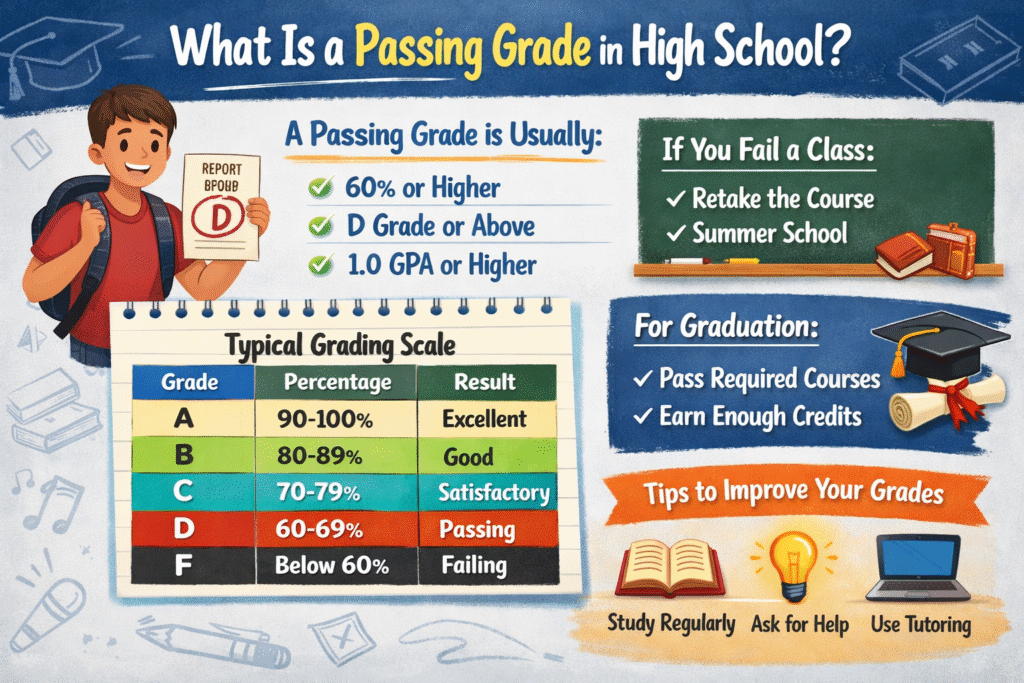
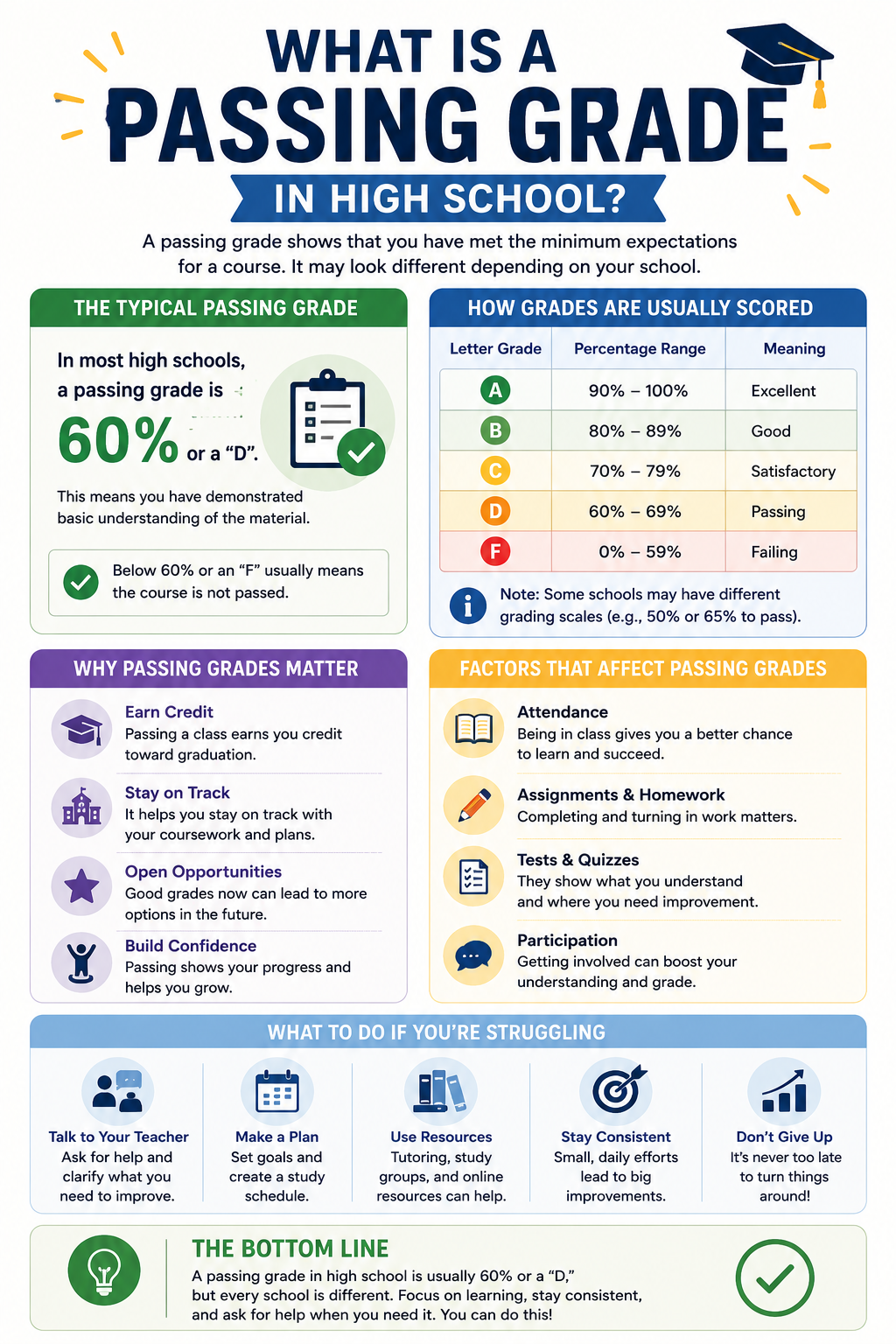
A pass grade at the high schools is the most basic score that a student needs to achieve in order to be able to complete a course and gain academic credits. The exact grade for passing will vary based on the nation, state, district or even by specific schools, the majority of high schools use a standard scoring scale in which at least 60% and greater is considered to be a passing score.
It is essential to know the passing grade for parents, children as well as teachers since those grades are the basis for advancement into the next grade, graduation eligibility and college-ready.
Also See: 16/20 Grade
What Is Considered a Passing Grade?
In the majority of high schools the criteria for passing is:
-
D or greater
-
60% – 69% as a percentage
-
1.0 GPA or higher
Some schools, however, have a requirement of the students to earn a C (70 percent) or more in order to be able to pass the entrance exam, particularly for fundamental subjects like Mathematics, English, Science, and Social Studies.
Explore More: 12/15 Grade
Common High School Grading Scale
Here’s a common grade scale that is used at a variety of high schools:
| Letter Grade | Percentage Range | Status |
|---|---|---|
| A | 90-100% | Excellent |
| B | 80-89% | Good |
| C | 70-79% | Satisfactory |
| D | 60-69% | Passing |
| F | Below 60% | Failing |
Important Point: A D usually is the most ineffective grade for passing However, it might not be enough to meet college graduation or admission requirements.
Does a D Count as Passing?
In many schools in many schools, a D can be considered an A grade as it permits students to earn credits for a course. However:
-
A few schools don’t allow D-grades to graduate.
-
The majority of colleges aren’t able to think of D grades as as competitive
-
Subjects with a high degree of complexity may need C or more
Always verify the school’s academic policies for confirmation.
Passing Grades by Country
United States
-
Passing grade: D (60%)
-
For graduation, it is often necessary to have a an average of C or better.
United Kingdom
-
GCSE passing grade: 4 or above
-
The grade 5 exam is thought to be an excellent grade to pass
Canada
-
Passing grade: 50%-60%, depending on province
Australia
-
Passing grade: 50%
What Happens If You Don’t Get a Passing Grade?
In the event that a student is unable to complete in a class:
-
You may have to take the class again
-
School for summer might be mandatory
-
The graduation ceremony could have to be delayed
-
GPA can be impacted negatively
Certain schools provide credit rehabilitation programs that help students catch up.
Also Check: Grading Chart
How Passing Grades Affect Graduation
In order to graduate from high school, students need to:
-
The core course requirements must be completed to pass.
-
You must earn a certain number of credits
-
Keep a minimum GPA
Inability to pass the test will stop students from getting enough credits for graduation on time.
Passing Grade vs. College Requirements
Even if the student is able to pass the high school class:
-
Colleges typically prefer C or better
-
The top universities are expected to have to see B and A scores.
-
An unsatisfactory grade in a passing test could hinder scholarship opportunities
It isn’t always enough to guarantee your future academic achievement.
Tips to Improve Your Grades
-
Regularly attend classes
-
Do all your assignments in time
-
Request help from teachers
-
Utilize online tutoring and resources or use tutoring
-
Keep track of your marks through the entire semester.
High School Grading Scales Across Different Schools
While many students ask what is a passing grade in high school, it’s important to remember that grading policies are not identical everywhere. Public schools, private schools, and school districts often establish their own grading scales, which means the minimum passing score can vary depending on where you study.
Most high schools use a combination of letter grades, percentages, and GPA values to measure academic performance. Teachers may also calculate final grades using weighted assignments, quizzes, exams, class participation, projects, and attendance. Because of these differences, two students with the same percentage could receive different final grades depending on their school’s grading policy.
Final Thoughts
A satisfactory grade at high school is typically 60 percent or higher; however, this may vary according to school policy and location. Passing allows students to advance academically, and using tools like Quick Grader can help track performance. Working toward higher scores increases the chances of college acceptance, graduation, and long-term career progression.
Frequently Asked Questions
What is a passing grade in high school?
A passing grade is the minimum score required to earn course credit. In many high schools, a D is considered passing, but some schools require a C or higher.
Is a D passing in high school?
Yes, a D is often considered a passing grade in many U.S. high schools. However, some schools, districts, or specific courses may require at least a C to pass.
What is the typical high school grading scale?
Most high schools use a grading scale based on A, B, C, D, and F, with each letter representing a percentage range. The exact percentage cutoffs vary by school.
Does every high school use the same grading scale?
No. Grading scales differ between schools, districts, states, and countries. Always check your school’s official grading policy for accurate requirements.
Why do passing grade requirements vary?
Schools may set different standards based on curriculum requirements, graduation policies, academic programs, and local education regulations.