
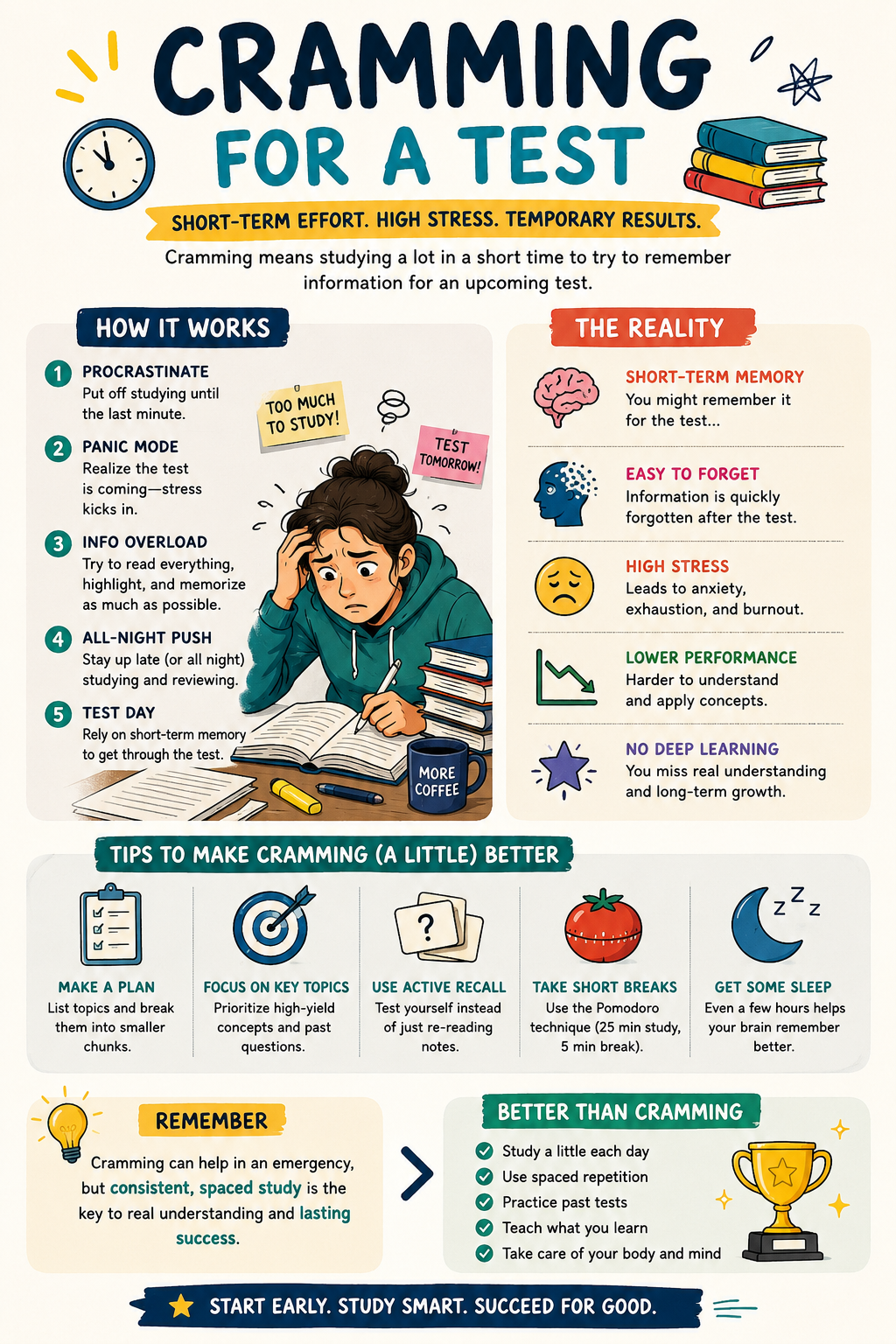
Most study advice tells you not to cram. Space your learning out over weeks. Build long-term retention. Review material in small doses across many sessions. That advice is entirely correct and also completely useless when your test is in three hours.
Cramming gets a worse reputation than it deserves. Research confirms that intensive short sessions can actually outperform the same number of study hours spread over time when the test is happening the next day. The limitation is that the information fades quickly after the exam. But if the goal tonight is tomorrow morning, that limitation does not matter.
The problem is not cramming itself. The problem is that most students cram badly. They sit down with everything in front of them, read through it with no system, feel vaguely prepared, and then forget most of it by the time the test starts. What follows is a practical guide to doing it right.
Set Up Your Space Before You Open a Single Note
Under normal study conditions, a slightly messy desk or some background noise is manageable. During a cram session, every distraction is disproportionately costly because you have no margin for wasted time.
Set up your space deliberately before you begin. Phone goes face down and silent, not just on do-not-disturb. Notifications visible on a screen are still distracting even when they make no sound. Close every browser tab not directly related to what you are studying.
What to eat and drink before you start
Drink water before sitting down. Mild dehydration reduces concentration faster than most students realize, and by the time you notice you are thirsty your focus has already dropped. Avoid a heavy meal right before your session.
A small amount of caffeine if you normally consume it is fine. Doubling your usual intake because tonight feels urgent tends to increase anxiety without improving recall. Keep things as close to normal as possible and let the session do the work.
Start With a Brain Dump, Not Your Notes
Before you look at anything you have written down, take a blank page and write everything you already know about the test topic. Do not organize it. Do not worry about whether every detail is accurate. Just write every term, concept, formula, date, or idea that comes to mind.
This does two things that passive reading cannot. First, it shows you exactly what is already in your memory so you can stop spending time reviewing material you already know. Second, the act of trying to retrieve something you almost know but cannot quite pin down creates a stronger memory trace than simply reading the answer would.
How to use your brain dump results
After the dump, compare what you wrote to your notes. The gaps between your page and your notes are your cram session. Everything that matches is already covered. This takes five minutes and saves you from spending the next two hours on material that was never actually at risk.
Sort Your Topics Into Three Groups Before Studying Any of Them
Go through your topics or chapters and sort them quickly into three groups before touching any of them in depth.
Group one: what you already know
Material you can explain without looking at notes. Leave this alone unless you finish everything else with time to spare. Reviewing it feels reassuring but produces almost no return.
Group two: what you know partly
Material you have seen before and can partially explain but cannot yet articulate clearly under pressure. This is where your time goes. You are not learning it from scratch, you are solidifying something that is already partly there. That is a much shorter path than starting from zero.
Group three: what you do not know at all
Material you have no real memory of and would need to build from scratch. If the test is tomorrow and you have two hours, this group gets 15 minutes maximum or nothing at all. Most students spend the majority of their cram time here because it feels most urgent. That instinct produces the worst returns.
A surface understanding of group three is sometimes worth pursuing if those topics are high-value on the test. Enough to attempt a partial answer beats leaving a question completely blank. If you are unsure how much any given score affects your standing, the grade scale at easygraders.com tells you exactly where you are and what tomorrow needs to do.
Use Time Blocks Instead of Open Sessions
When there is no structure to a cram session, time disappears. Students look up and realize 45 minutes passed while they stared at the same two pages. Set a timer for 25 minutes per topic from your group two list. When it goes off, spend three minutes writing a brief summary of what you just covered. Then move on regardless of whether you feel finished.
Moving on is the part students resist most. They want to feel fully confident about one topic before touching the next. That feeling rarely arrives under time pressure anyway, and waiting for it means some topics never get touched at all. A surface-level review of five topics serves you better in most cases than a deep review of two.
Cycling between topics within a session
Work on topic A for 25 minutes. Switch to topic B for 25 minutes. Come back to topic A briefly before moving to topic C. The act of switching away and returning is doing memory work even when it does not feel like studying. Short-term retention under time pressure improves when you see material more than once with a gap in between, even a small gap.
Use a Faster Version of Active Recall for Cramming
In a regular study session, active recall means covering your notes and trying to reproduce everything about a topic before looking. During cramming you often do not have enough time for a full attempt on every topic.
A faster version works well under pressure. Read a section of your notes once, cover it, and try to state the three most important points from that section in your own words. You are not aiming for total recall. You are aiming for core idea retention.
Why three core ideas is enough for most tests
If you can identify the three most important things about each topic and explain them simply, you will handle the majority of questions that appear. The edge cases and fine-detail questions are worth fewer points and cost more time than they return.
Students at a 15/20 grade or a 19/20 grade going into a cumulative assessment are in very different positions. Knowing that going in changes how much risk you take on unfamiliar material and how much time you give to the topics already in your group two list.
Cram by Question Type, Not by Chapter
Most students organize cramming by chapter because that is how notes are arranged. A better approach when time is short is to organize by the format of tomorrow’s test.
Multiple choice tests
Multiple choice requires recognition, not production. Your goal is to get familiar enough with the material that the right answer looks more right than the wrong ones. That is a lower bar than producing the answer from scratch, which means you can move through more material in the same time.
Essay and short answer tests
Essays require you to construct an argument or explanation. For these, practice writing one or two sentences summarizing your position on each likely topic. You are not writing the full essay tonight. You are making sure you know what you would say so you are not deciding your position in real time during the test, which costs valuable minutes.
Problem-based and calculation tests
For math, science, or any problem-based test, do one or two practice problems per topic rather than reading through worked examples. There is a meaningful difference between following along with a solution and solving a problem independently. Only the second version prepares you for tomorrow.
Build a One-Page Reference Sheet as You Go
As you move through your session, build a single sheet with the most important point from each topic. Not summaries. Not definitions written out in full. Just the core idea in as few words as possible.
By the time you finish your session, this sheet becomes your final review before sleep and the thing you glance at in the morning. The act of building it forces you to decide what matters, which is a form of active processing that rereading cannot replicate.
Students sitting at a 22/25 grade going into a test that could shift their overall standing know which points to prioritize on that sheet. Students at an 18/25 grade who need a strong result to change their average need a different allocation of time across topics. The grade scale calculator shows exactly what tomorrow’s score needs to look like.
What to Do in the Final 20 Minutes of Your Session
Stop taking in new material. Close your notes. Pick up the one-page sheet you built during the session and read through it once. Then put it down and try to reconstruct it from memory on a blank page.
Whatever you cannot write down is what you spend the remaining minutes on. Everything else is consolidated well enough. Students who score a 23/25 grade or a 24/30 grade after cramming are rarely the ones who studied longest. They are the ones who stopped adding new material early enough for what they already reviewed to settle before sleep.
More cramming time does not always mean better results. The law of diminishing returns kicks in faster under time pressure than during regular studying. Finishing at a reasonable hour and getting enough sleep almost always beats staying up past the point where you are genuinely absorbing anything.
When Cramming Is Not Going to Help and What to Do Instead
Cramming works for reinforcing material you have partially encountered. It does not work for building knowledge from scratch in a cumulative subject where later concepts depend on understanding earlier ones.
If you have genuinely missed weeks of class or readings and the test covers that material, a three-hour cram session is not going to bridge that gap. In these cases the better move is to identify the handful of topics you can realistically get a surface handle on in the time available and accept partial coverage rather than attempting everything shallowly.
Scoring well on three topics and leaving two blank often beats scoring poorly across all five. For students managing a cumulative grade who want to understand what they actually need from tomorrow’s result, the what is a passing grade in high school guide on easygraders.com lays out the thresholds clearly without requiring you to run the math yourself.
Frequently Asked Questions About Cramming for a Test
Q: Does cramming actually work for tests?
Yes, cramming can work for next-day tests. Research shows that intensive short sessions can produce better same-day results than the same number of hours spread out over time, because massed repetition strengthens short-term recall. The limitation is that cramming rarely transfers information to long-term memory, so material fades quickly after the exam. For a test happening tomorrow, that trade-off is worth making.
Q: How long should a cram session be?
Most students get the best results from sessions between 60 and 90 minutes. Beyond that, concentration drops and the material you are reviewing stops sticking as well. If you have more time than that, take a 20-minute break and do a second session rather than pushing through one long unfocused one. Two 75-minute sessions with a break in between produce better retention than one 3-hour marathon.
Q: What is the most effective technique when cramming?
Active recall gives you the best return per minute when cramming. Rather than reading through notes, cover them and try to state the most important points from memory. What you cannot reproduce is what needs more time. Reading feels productive but produces much weaker retention than trying to retrieve information independently, even when that retrieval is imperfect.
Q: Should I stay up all night to cram before a test?
Almost never. Sleep is when your brain consolidates what you reviewed into retrievable memory. Cutting sleep to add more study time means the material from your earlier session is less likely to be accessible the next morning, and your cognitive performance on the test itself drops. Finishing your cram session by midnight and getting at least six to seven hours of sleep produces better test results in nearly every case.
Q: What should I study first when cramming?
Start with material you have partially covered but cannot yet fully explain, which is where your efforts produce the fastest gains. Avoid spending most of your time on material you genuinely know nothing about, since building knowledge from scratch in an hour rarely works. Also avoid reviewing topics you already know well, since that time produces almost no return. Sort your topics quickly into what you know, what you partly know, and what you do not know at all, then give almost all your time to the middle group.
Q: Is it better to cram alone or with a group?
For most students, cramming alone is more efficient when time is the main constraint. Group sessions often drift into conversations and uneven pacing. The exception is if you plan to use the explain-it-out-loud technique, where having someone to talk through the material with genuinely helps. If studying with others, set a strict agenda and a time limit before sitting down.
Q: What should I do the morning of the test after cramming?
Do not open new material the morning of the test. Look over the one-page reference sheet you built during your session the night before, eat something that is not pure caffeine and sugar, and give yourself a few minutes without screens before walking in. New information the morning of a test tends to create interference with what you already reviewed.
Q: How do I know if my grade can survive a bad test result?
The fastest way to figure that out is to check your current grade standing and calculate what score you need from tomorrow’s test to stay above your target threshold. The grade scale on easygraders.com lets you check exactly what a specific result means for your overall standing without any manual math. Knowing the number going in changes how you allocate your cram time and how much risk you take on unfamiliar material.