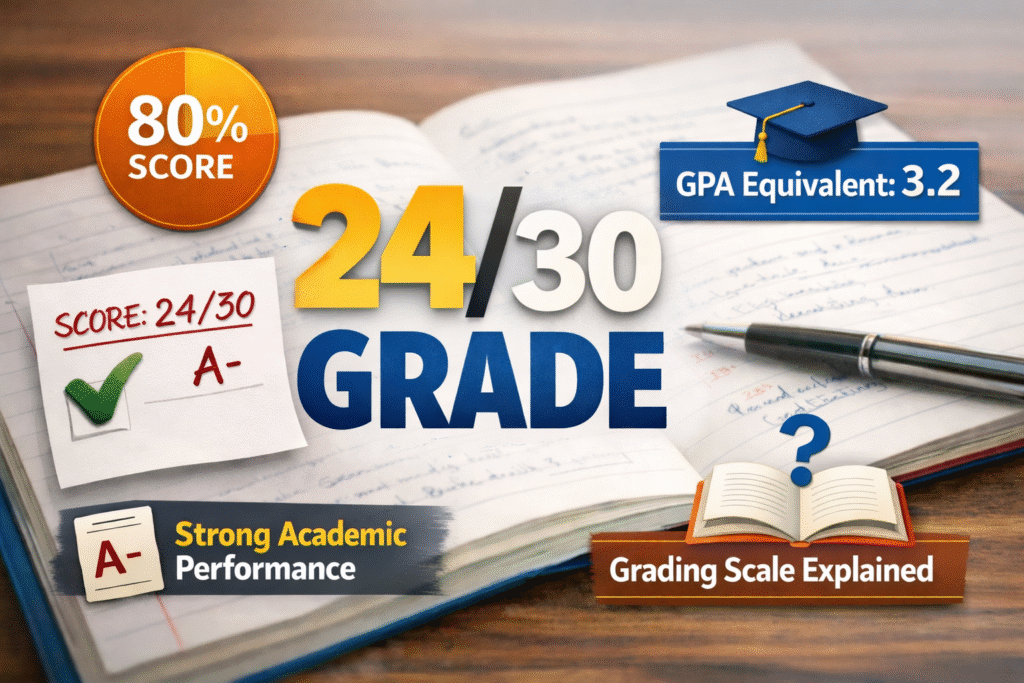
24 out of 30 is 80%, which is a B− letter grade and a 2.7 GPA on a standard 4.0 scale. It is a passing grade at every common threshold. Grades, at least in my opinion, can be difficult to interpret when it comes to assessments, particularly when they don’t adhere to the traditional 100-point scale. The “24/30 grade” would be an example; whether in academics or elsewhere, knowing what you actually got or earned can help you figure out your performance and how to do better. Using a Quick Grade approach can make such evaluations easier to understand. In this post, we will explain what is a 24/30 grade in academia, how it’s measured compared to other grading systems, and what you can do to increase your grades in both an academic or professional environment.
What Does 24/30 Grade Represent?
A “24/30 grade” means that, on a scale of 30 points possible, you earned 24. This system has been accepted as a part of various grading scenarios, and even some industry sectors which value performance or quality based on points.
Rest of Europe: 24/30 in academic grading for universities in countries that explicitly use a grading system out of 30 points. It means you have obtained 24 of the 30 possible points, and thus a score of 80%. This is generally what I would call a good “B” – performance. It’s not perfect, but it demonstrates you have a fairly good grasp of the content overall, though some details could use more work.
In Other Areas: 24/30 scores can show up in other places, such as product quality evaluations and employee performance or project assessments. So in a manufacturing or project-management setting, 24/30 might signify that something (a product, say) has met most of the standards but could use some rounding out around the edges.
| Score | Percentage | Letter Grade | GPA |
|---|---|---|---|
| 30/30 | 100% | A+ | 4.0 |
| 29/30 | 96.7% | A | 4.0 |
| 28/30 | 93.3% | A | 4.0 |
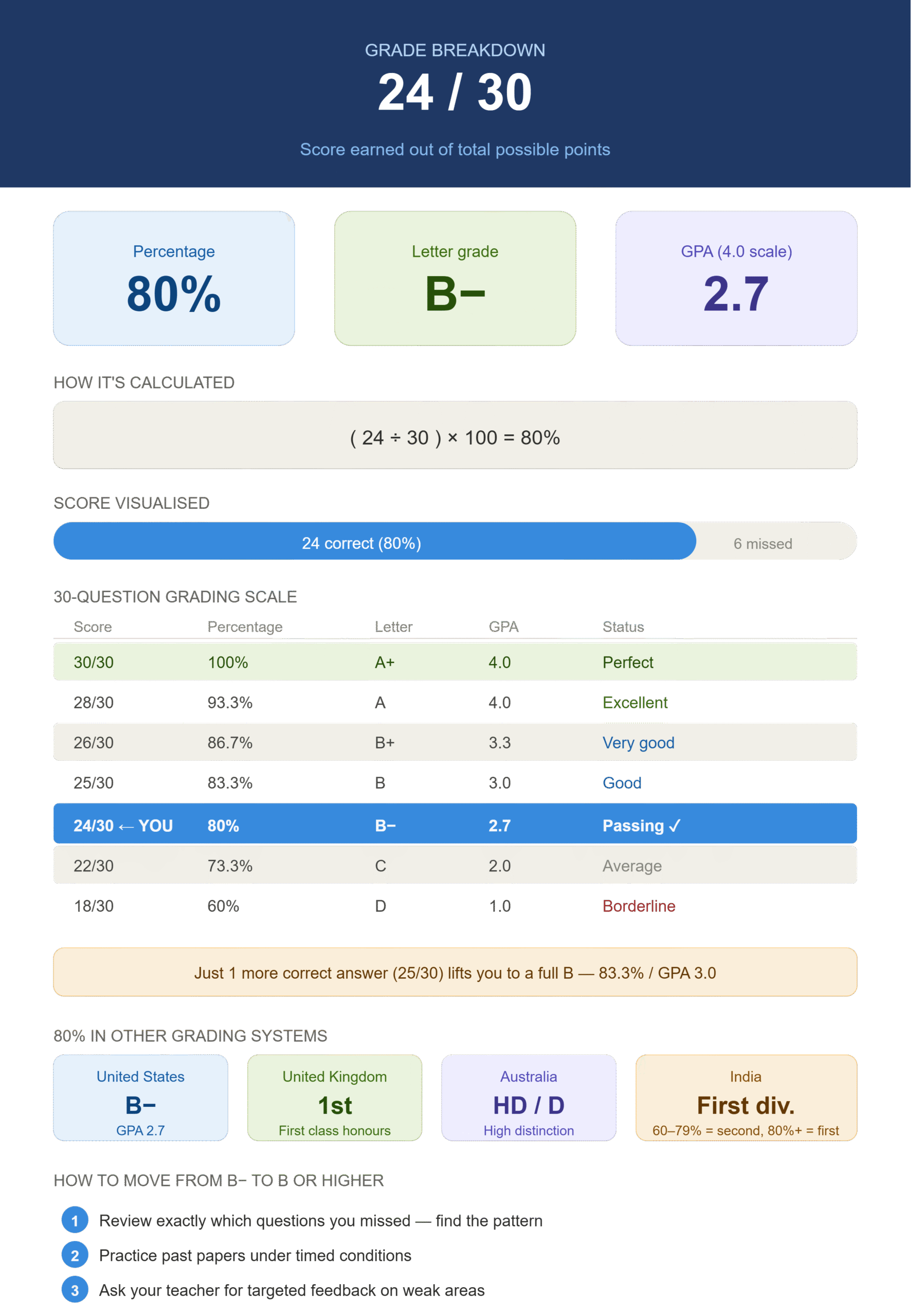
| 24/30 | 80% | B− | 2.7 |
| 23/30 | 76.7% | C | 2.0 |
Why Does 24/30 Matter?
And having a sense of what a grade of 24/30 means in your field can give you insight into where exactly you fall. If you’re a student or a professional, this is why it matters:
In Education: Receiving a 24/30 means you did well but not flawless. This grade is usually a sign that you understand most, but not all of the material. It’s a solid score, yet there are ways to keep improving and break into the A-grade range (28/30 or higher). It’s crucial for students aspiring to score in the high percentiles to evaluate where points were squandered, and work on improving those skills.
Professional Evaluations: In a professional environment (on project evaluations or product ratings), a 24/30 grade probably means you’re close but not quite at the top of your game! If your project or product garners a 24/30, it’s considered passable — but with some things to work on. And this feedback can point the way for additional efforts so you get a good score and satisfying feeling of completion next time.
Check this: 15/20 Grade
How to Raise Your Education Grade from 24/30
If you got 24/30 and you’re trying to improve your score, here are some strategies:
Analyze Your Errors: Re-review your test or homework. Which areas cost you points? Misinterpretation of the subject, lack of information, or errors? Know where did you make mistake and it is the first step to improvement.
Review Key Concepts: Target your weaknesses. Revisit anything that has given you trouble, be it specific topics or certain types of questions. Ensure you understand all the key concepts thoroughly.
More Practice: All too frequently, the distance between a 24/30 and perfection is practice. In the event that you can find more problem sets, mock tests or previous assignment, work your way through would help in maintaining your sharpness and increase accuracy.
Ask for Feedback: Do not hesitate to seek feedback from your teacher or mentor. Knowing what you might do differently in the future is valuable to improving how well you perform.
Management of Time: Poor time management is among the top causes for students not attaining better grades. Learn to not rush and spend the necessary time in order all questions to be answered properly.
View More: 18/25 Grade
How 24/30 Grading Works in Professional?
In sectors such as manufacturing, construction or service inspections the 24/30 class can also refer to the quality of a product, service or project. You can think of a 24/30 grade in that context as follows:
Project Management: If a project is 24/30, you have basically finished the minimum requirements and meet most of the criteria, but there might be some aspects missing that if included would significantly improve the project in your favor. This is telling me that there’s some tweaking or more work to be done before things are entirely satisfactory.
Product Quality: A product with a score of 24/30 has most likely passed many quality assurance checks, but still might require some fine-tuning. It’s a marker for when the product is just about perfect, but needs some tweaking to reach full-on greatness.
How to Score Better on Performance Evaluations
Honing your 24/30 in professional evaluations takes attention to detail and a commitment to get better:
Find Weaknesses: As in education, it’s also crucial to identify where you and your clients need improvement. Examine those areas of the project, product or service that got lower scores and determine what went wrong.
Take Action: Once the weak points have been made clear, make a plan to solve them. Whether it’s being a better communicator, maintaining quality control, or improving processes there are actually things you can DO to raise your game.
Ongoing Assessment: Frequently check to see that your work (or project) is up to necessary standards. Frequent check-ins can stop small problems from becoming larger ones.
Quality Assurance: Spend the time performing quality control on your work before submission or launch. This could minimize the errors and can improve your score in upcoming exams.
Explore more: 16/20 Grade
Conclusion
A 24/30 is good but not great — nothing to write home about. Regardless of whether you’re a student or working professional, knowing this score can guide where to add value. In education, it’s a pretty thorough understanding of the material; in professional situations, you’re nearing completion of meeting all prerequisites. Learning from our mistakes, practicing extra, asking for feedback and dialing in the process can help you turn a 24/30 into high-water marks in any industry.
Frequently Asked Questions
Q1: What is 24 out of 30 as a percentage?
24 out of 30 is 80%. The formula is: (24 ÷ 30) × 100 = 80%. This is calculated by dividing the score earned (24) by the total possible points (30) and multiplying by 100.
Q2: What letter grade is a 24/30?
A 24/30 (80%) is a B− on the standard US grading scale. On simplified grading scales used by many schools, it falls within the B range (80%–89%). The exact letter grade can vary depending on whether your school uses plus/minus grading.
Q3: What GPA is a 24/30?
A 24/30 (80%) converts to approximately 2.7 GPA on a standard unweighted 4.0 scale, corresponding to a B−. In weighted GPA systems (AP or Honors courses), the same score may contribute up to 3.7 GPA points.
Q4: Is 24/30 a passing grade?
Yes. A 24/30 (80%) is a passing grade under every common threshold — including 60%, 65%, 70%, 75%, and 80%. It meets even the strictest standard passing requirement exactly at 80%.
Q5: How many questions can you miss on a 30-question test to get a B−?
To earn a B− (80%) on a 30-question test, you need at least 24 correct answers — meaning you can miss a maximum of 6 questions. Missing 7 or more (scoring 23/30 = 76.7%) would drop you below the B− threshold.
Q6: How close is 24/30 to the next letter grade?
Just one correct answer separates 24/30 (B−, 80%) from a full B. Scoring 25/30 gives 83.33%, which earns a B on the standard grading scale. Two more correct answers (26/30 = 86.7%) would earn a B+ on detailed scales.
Q7: What is 24/30 in UK grading?
In the UK university grading system, 80% falls within the First Class Honours band (70% and above). A 24/30 in a UK university context is an excellent result and would be considered a First.
Q8: How can I improve from a 24/30 on my next test?
To move from 24/30 to 25/30 or higher: (1) Review the specific questions you missed and identify the pattern — were they from one topic? (2) Practice with past papers under timed conditions. (3) Use office hours to clarify weak areas before the next exam. (4) Focus study time on the 20% of material that cost you marks rather than reviewing everything equally.