
Every student has seen it at least once — that extra question sitting quietly at the bottom of the exam paper, separate from the main questions, often worth a few “free” points. These are known as bonus questions in exam, and while they might look like a small detail, they can actually make a noticeable difference to your final grade.
In this article, we’ll break down what bonus questions are, why teachers include them, how they affect grading, and how tools like an online grading calculator can help both students and teachers understand their real impact on a final score.
What Are Bonus Questions in an Exam?
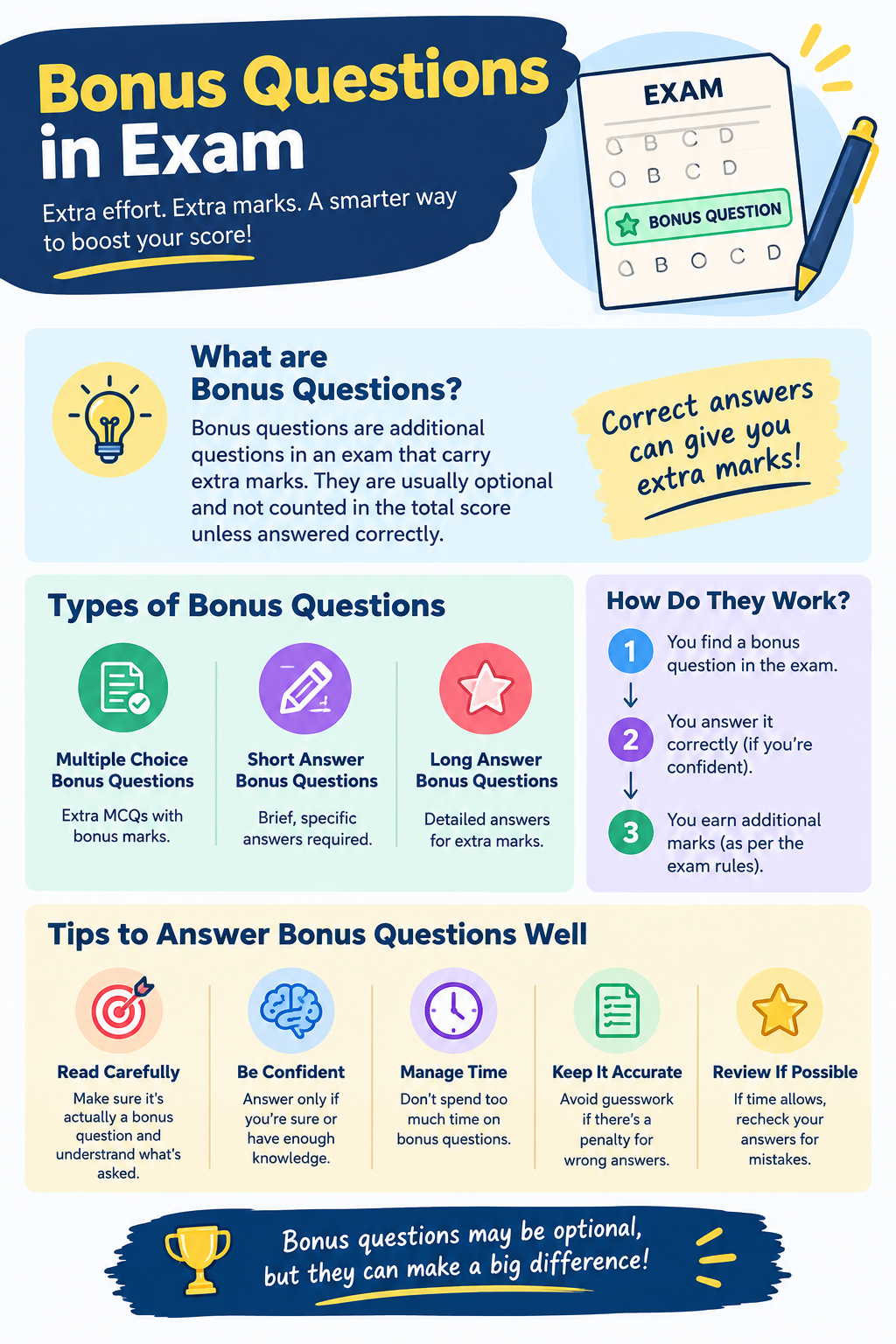
A bonus question (also called an extra credit question) is an additional question added to a test that is not part of the required questions needed to score 100%. Students can attempt it for extra points, but skipping it usually doesn’t result in any penalty.
Bonus questions are commonly used to:
- Reward students who go beyond the basic requirements
- Test deeper understanding of a topic
- Balance out difficult exams by offering a safety net
- Encourage critical thinking or creativity
Unlike regular questions, bonus questions are optional — but the points they offer are very real when it comes to calculating your final percentage.
Why Do Teachers Add Bonus Questions?
Teachers add bonus questions for a variety of pedagogical and practical reasons:
- To reduce test anxiety — Knowing there’s a chance to earn a few extra points can ease pressure during exams.
- To differentiate high performers — Bonus questions often challenge students who have already mastered the core material.
- To offset a difficult exam — If an exam turns out to be harder than expected, bonus points can help balance the overall class average.
- To reward extra effort — Some bonus questions test outside knowledge or ask for more detailed answers than the minimum required.
How Do Bonus Questions Affect Your Grade?
This is where things get a little tricky for both students and teachers. Bonus points are usually added on top of the total possible score, which means your percentage can technically go above 100%.
For example, if an exam has 100 regular points and a 5-point bonus question, a student who answers everything correctly, including the bonus, could score 105 out of 100 — a 105%.
Because this calculation isn’t always straightforward, many students and teachers turn to a quickgrade tool to instantly calculate grades that include bonus points, instead of manually working out percentages by hand.
Manual Calculation vs. Using an Easy Grader
Calculating grades manually when bonus questions are involved can lead to errors, especially when dealing with:
- Fractional bonus points
- Multiple bonus questions
- Partial credit combined with bonus credit
- Weighted grading systems
This is exactly why platforms offering an easy grader have become so popular among teachers. Instead of manually calculating each student’s score, educators can input the total questions, correct answers, and bonus points, and instantly get an accurate grade — saving time and reducing human error.
If you want to visually understand how each score translates into a letter grade, a grading chart is an excellent reference. It shows how raw scores, including bonus points, map onto standard grading scales (A, B, C, etc.), giving students a clearer picture of where they stand.
Should Bonus Questions Be Mandatory?
No — by definition, bonus questions are optional. However, students are always encouraged to attempt them because:
- They provide a cushion against mistakes made elsewhere in the exam
- They can boost your overall grade or GPA
- They often test knowledge that reinforces core concepts
Even attempting a bonus question partially can sometimes earn partial credit, depending on the grading policy of the instructor.
Tips for Tackling Bonus Questions in Exams
- Finish the main exam first — Never risk losing points on required questions by spending too much time on a bonus question.
- Read the bonus question carefully — Bonus questions are sometimes tricky or designed to test lateral thinking.
- Attempt even if unsure — Partial answers may still earn partial credit.
- Manage your time — Only attempt bonus questions once you’re confident about the rest of the exam.
- Don’t panic if you skip it — Bonus questions are extra, not mandatory, so missing one won’t hurt your baseline score.
How Students Can Track Their Grades With Bonus Points
If you’re a student trying to understand how bonus questions affect your GPA or semester performance, using a dedicated grading tool can help you track scores accurately over time. Many students also use their university’s official portal to check grades and academic records. For example, university students often rely on their institution’s dashboard similar to the gcu student portal to view final grades once bonus points and other adjustments have been factored in by instructors.
Combining an official student portal with an independent grading tool gives you a well-rounded way to verify your scores and catch any discrepancies early.
Final Thoughts
Bonus questions in exams are a small but meaningful part of the academic grading process. They reward extra effort, ease exam pressure, and can meaningfully boost your final score when used strategically. Whether you’re a student trying to calculate your potential grade or a teacher looking for a faster way to process scores, using tools like an online easy grader or a grading chart can make the entire process far more accurate and efficient.
So next time you spot that extra question at the bottom of your exam paper, don’t skip it without a second thought, it might just be the difference between a good grade and a great one.