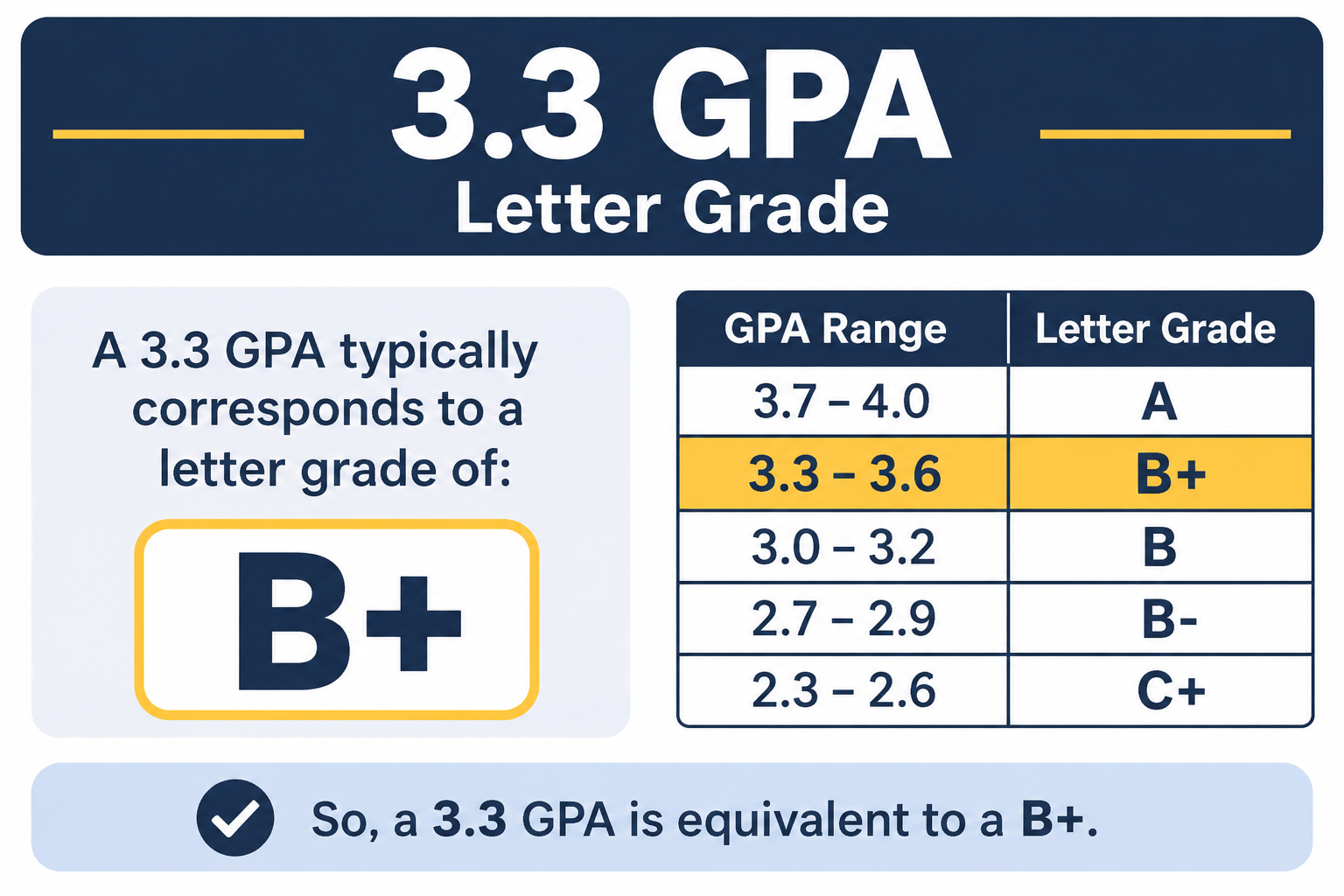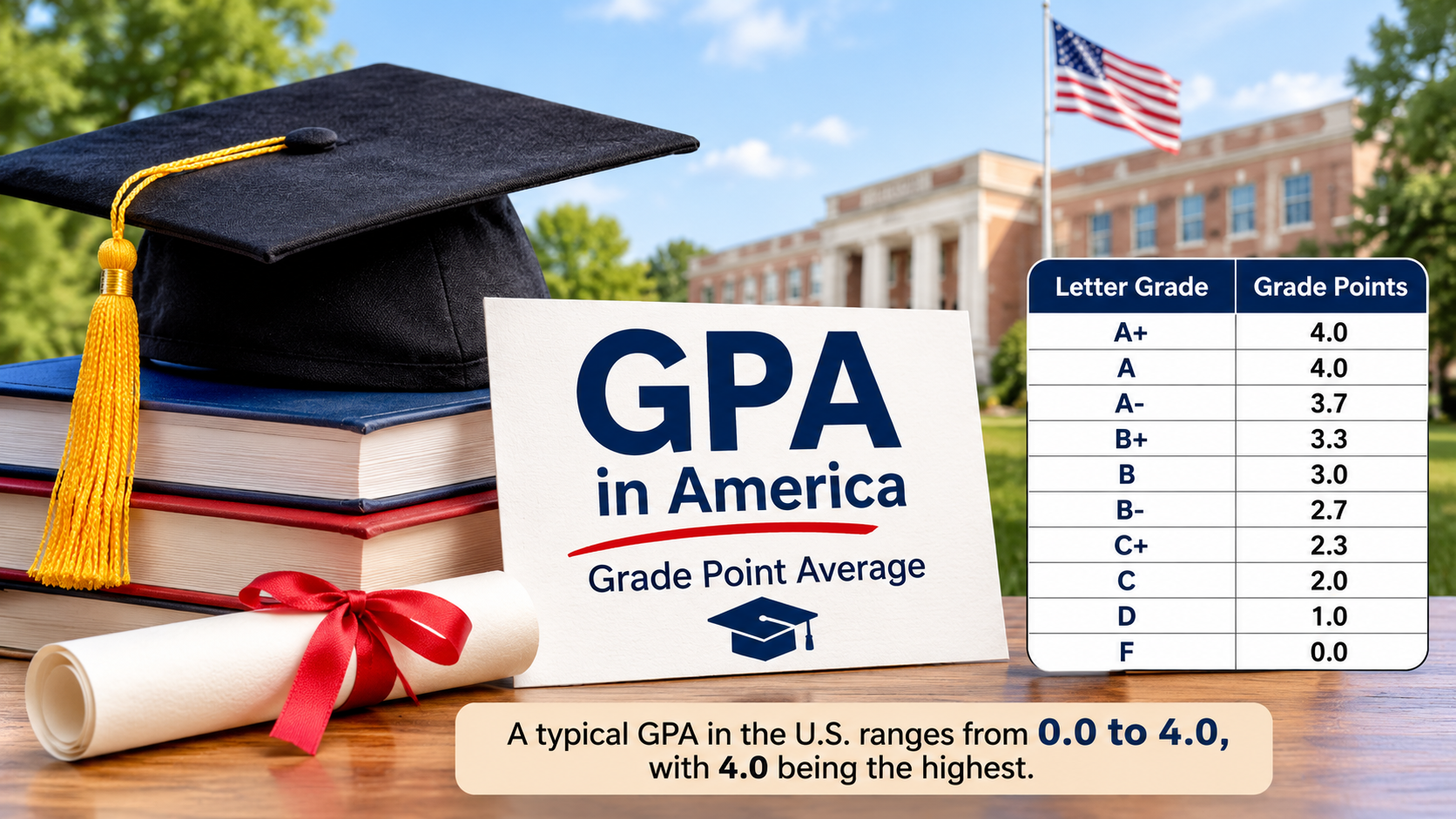
Short answer: a 3.3 GPA is a B+ on the standard 4.0 scale. In percentage terms, that usually lands around 87% to 89%. If that’s all you needed, you’re done. But if you’re wondering whether a 3.3 is actually good, what doors it opens, or how to push it higher, keep reading.
A number on a transcript can feel strangely abstract. Below, we break down what a 3.3 really says about your grades, how colleges see it, and what you can do next.
What Letter Grade Is a 3.3 GPA?
On the most common US scale, a 3.3 sits exactly at B+. Here is where it fits among its neighbors:
| Letter Grade | Percentage (typical) | GPA Points |
| A | 93–100% | 4.0 |
| A- | 90–92% | 3.7 |
| B+ | 87–89% | 3.3 |
| B | 83–86% | 3.0 |
| B- | 80–82% | 2.7 |
Two quick notes. First, percentage cutoffs are not national. Some schools draw the B+ line at 88%, others at 86%, so check your own grading policy. Second, a few schools don’t use plus and minus grades at all. In that case, a 3.3 would fall somewhere between a B and an A.
A 3.3 Overall GPA Isn’t Always All B+ Grades
This trips up a lot of students. When someone says “I have a 3.3 GPA,” they usually mean a cumulative average, not a transcript full of B+ grades. A mix of grades can easily add up to the same number.
Here’s one simple example with five equal-credit classes:
| Course | Grade | GPA Points |
| English | A | 4.0 |
| Biology | B+ | 3.3 |
| Math | B | 3.0 |
| History | B | 3.0 |
| Psychology | B+ | 3.3 |
| Average | 3.32 |
One A, two B+ grades, and two B grades give you roughly a 3.3.
To try your own combination, plug your courses into the GPA calculator on Easy Graders. It takes a minute, and it handles credit hours too, which matter more than most students expect.
Is a 3.3 GPA Good?
Yes. A 3.3 is above average and shows consistent, solid work. Most American high schools and colleges consider anything above a 3.0 a respectable B average. Here is what it generally means in different settings:
- High school: Competitive for many state universities and a wide range of colleges. Highly selective schools usually look for higher, though course difficulty and the rest of your application matter a lot.
- College: Comfortably above the 2.0 needed for good standing at most schools, and strong enough for many majors, clubs, and internships.
- Scholarships: Many programs set a minimum of 3.0, so a 3.3 clears that bar. Some merit awards ask for 3.5 or more, so read each requirement closely.
- Graduate school: Many programs list a 3.0 minimum, though competitive ones expect more. Strong test scores, research, or work experience can balance things out.
What About Weighted GPA?
If your school uses a weighted scale, the same 3.3 can look different. Honors classes often add 0.5 points and AP or IB classes commonly add 1.0. So a B+ in an honors course might count as 3.8, and a B+ in an AP course as 4.3. On the other hand, if a 3.3 is your unweighted GPA while you’ve taken a demanding course load, admissions officers will usually notice that effort.
Does a 3.3 GPA Qualify for Honors?
It depends on the school. Dean’s List cutoffs are often around 3.5, so a 3.3 may fall just short. Latin honors such as cum laude commonly start somewhere in the mid-3.0s or higher, but every university sets its own line. The good news is that a 3.3 sits close enough that one or two strong terms can change the picture.
If you attend Grand Canyon University, you can reach the student, faculty, and parent logins on the GCU Portal page and check your grades and progress there.
How to Raise a 3.3 GPA
The higher your credit total, the slower your GPA moves, so it helps to see how much work a goal actually takes. For example, imagine you have 60 credits at a 3.3 average. To reach a 3.5 cumulative GPA, you would need about 24 more credits of straight A’s. That is roughly two full semesters. It’s very doable, but it takes steady effort rather than a single great term.
A few practical ways to move the number:
- Aim for the high-credit classes. A 4-credit course affects your GPA more than a 1-credit one.
- Check your standing at midterms. You can still change your result while the term is running.
- Retake low grades if your school allows replacement. A D or C can drag more than you’d think.
- Don’t overload a single semester. Spreading tough classes out beats cramming them together.
- Get help early. Tutoring, office hours, and study groups are most useful before grades slip.
- Plan with numbers. Use the Easy Graders calculator to find out what you need on your next exam or in your final course grade to hit a target.
Frequently Asked Questions
What letter grade is a 3.3 GPA?
A 3.3 GPA equals a B+ on the standard 4.0 scale.
What percentage is a 3.3 GPA?
Usually around 87% to 89%, though the exact range depends on your school’s grading scale.
Is a 3.3 GPA good for college?
Yes. It’s above average and is accepted at many colleges and universities, although very selective schools often expect higher.
Can I get a scholarship with a 3.3 GPA?
Yes. Many scholarships ask for a 3.0 minimum, while some competitive awards require 3.5 or higher.
Is a 3.3 GPA an A or a B?
It’s a B+, which is the top of the B range and just below an A-.
How can I raise a 3.3 GPA to a 3.5?
It depends on how many credits you already have. With 60 credits at a 3.3, you’d need about 24 additional credits of straight A’s.
Final Thoughts
A 3.3 GPA is a B+: a strong, dependable result that opens plenty of doors. It isn’t the top of the scale, but it’s well above average, and it’s close enough to the next tier that focused effort can lift it. Know your scale, track your credits, and use the numbers to plan your next semester rather than worry about the last one.