
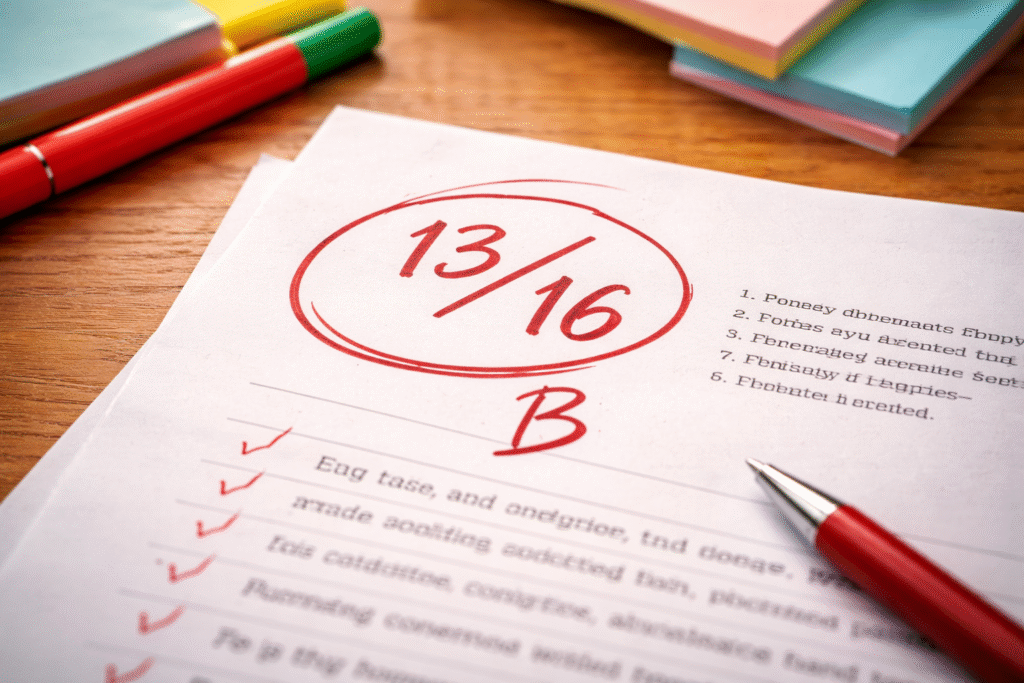
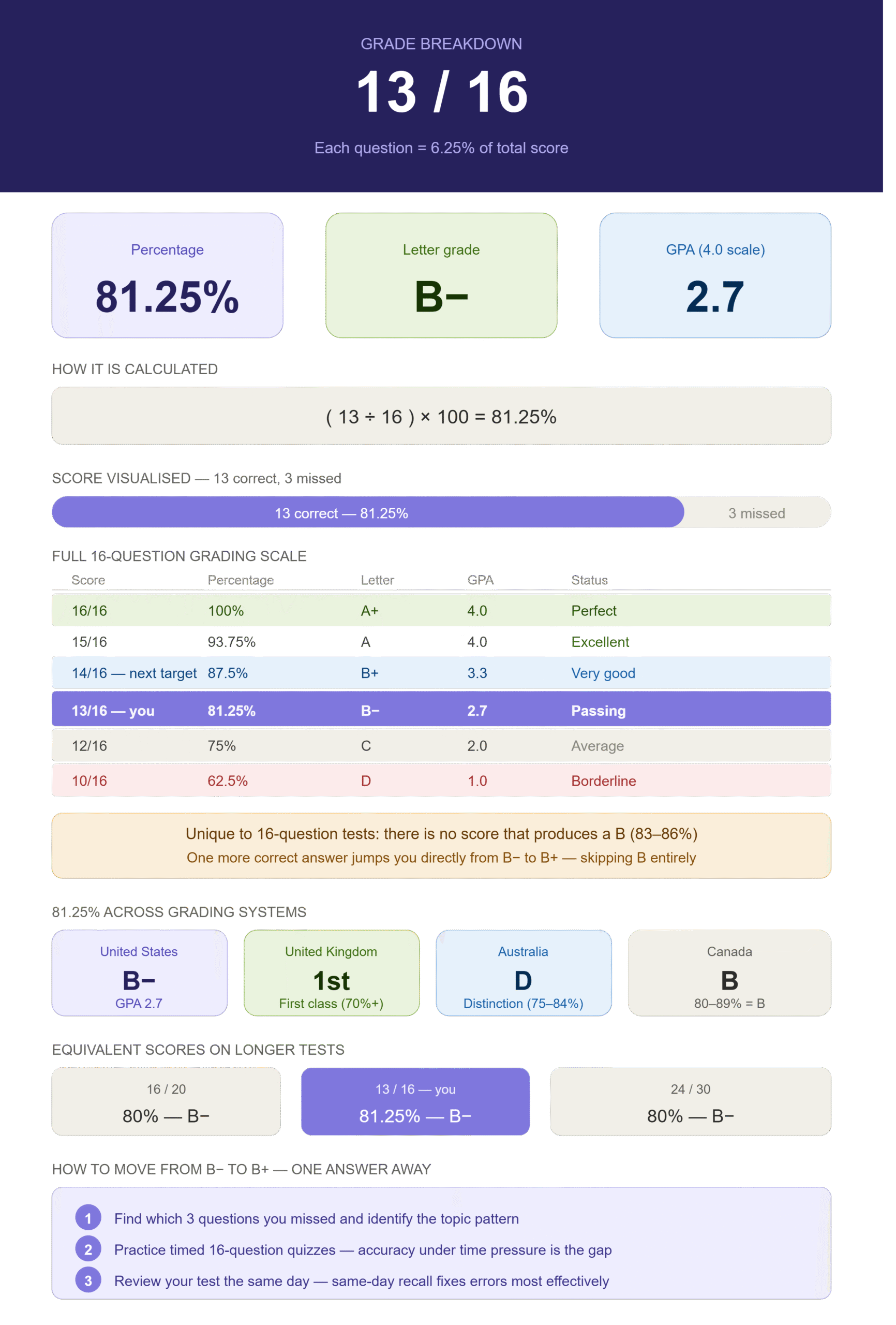
13 out of 16 is 81.25%, which is a B− letter grade and a 2.7 GPA on a standard 4.0 scale. It is a passing grade at every common threshold. Each question on a 16-point test is worth 6.25% — so one more correct answer (14/16) lifts you to B+ at 87.5%. With regards to the education system and its grading system different terms and slang could be confusing for students as well as teachers. For instance, one of these terms can be “13/16 grade.” This simple number has special significance in grading methods, usually when it comes to special grade scales. The article explores the significance of this grade and how it is used and the way it could influence students and schools equally.
Also Read: 16/20 Grade
What is a 13/16 Grade?
A grade of 13/16 can be defined as a number which is expressed as a fraction. 13 is the amount of correct answers while 16 represents the number of questions or the questions on the exam or homework assignment. This basically means that a student scored 13 points from a total of 16 points. The grade could be converted into percentages, or transformed into different grading systems, based upon the standards of the institution. On a 16-question test, each question carries 6.25% weight — more than on longer tests. This means a single answer has a meaningful impact on your final grade. Understanding how to read scores like this is part of using a reliable grade scale to track your performance accurately.
13/16 grading scale — full 16-question chart
| Score | Percentage | Letter Grade | GPA |
|---|---|---|---|
| 16/16 | 100% | A+ | 4.0 |
| 15/16 | 93.75% | A | 4.0 |
| 14/16 | 87.5% | B+ | 3.3 |
| 13/16 | 81.25% | B− | 2.7 |
| 12/16 | 75% | C | 2.0 |
| 11/16 | 68.75% | D+ | 1.3 |
| 10/16 | 62.5% | D | 1.0 |
| 9/16 | 56.25% | F | 0.0 |
Note: On a 16-question test, B+ is skipped between B− and A− — there is no score that produces a percentage in the 83–86% range. This is normal on shorter tests where each question jumps the percentage by 6.25%
Is 13/16 a passing grade?
Yes. A 13/16 (81.25%) passes at every standard threshold used in US schools — 60%, 65%, 70%, 75%, and 80%. It comfortably clears even the most demanding passing requirements. If your school requires 80% to pass a course, 13/16 meets that bar exactly at 81.25%. You can check what counts as passing at your level in our guide to what is a passing grade in high school.
How does 13/16 compare to nearby scores?
Knowing where you stand relative to the surrounding scores helps you set a concrete improvement target.
- 12/16 (75%, C) — one answer below 13/16 drops you out of the B range entirely into C territory. See 12/20 grade for how 75% compares on longer tests.
- 13/16 (81.25%, B−) — your current score.
- 14/16 (87.5%, B+) — just one correct answer higher, and you skip past B straight to B+. This is the most impactful single-answer jump on a 16-question test.
For context on similar score ratios, see how 11/15 grade (also 73.3%) and 22/25 grade (88%) compare. If you are working toward higher scores on 25-point tests, check 17/25 grade and 18/25 grade.
How is the 13/16 Grade Used in Educational Settings?
The 13/16 grade is commonly employed in cases in which the raw score (number of correctly answered questions) are being analyzed. This is especially common when:
-
Multiple Choice Exams: A grade of 13/16 can refer to the student’s score on a multiple choice exam in which they had to answer the correct questions out of 16.
-
Questions and Assignments: For quizzes and assignments requiring fixed points 13/16 marks the accuracy of your work as well as a thorough understanding of the topic.
-
Custom Grade Scales: A few educational institutions utilize custom grade scales, in which a number like 13/16 is more significant as a percentage, or letter grade. It could be the case in some vocational schools or in specific locations.
Read More: 11/15 Grade
Converting the 13/16 Grade to different Grading Systems
The 13/16 grade, although typically used in fractional form but it could be converted into a variety of different grading systems like:
-
letter grades: A: In a number of grades, a mark of 81.25 percentage is usually an average letter grade of “B” or “B+” (depending on the scale). This is an excellent passing grade showing a solid understanding and expertise with the topic.
-
Point System: in point-based grading methods, the score of 13/16 may contribute to a higher overall score. If, for instance, the assignment or exam is with a value of 100 points, then the 13/16 score could be part of an overall measurement metric for assessment.
-
“Pass/Fail” Systems: in some institutions, the 13/16 mark may be simply interpreted as an “pass,” especially if the passing minimum is at least 80. It would mean that the student has shown adequate knowledge of the subject.
Benefits of Using the 13/16 Grade System
There are a variety of advantages to the use of fractional grades, such as 13/16.
-
A clear and precise assessment: Fractional scores offer a deeper understanding of how a student’s performance compares to categorizing their results as letters grades. The result gives both students and teachers alike an comprehension of areas in which improvements could be necessary.
-
Motivation to Improve: Aside from the average in the range of “B,” the 13/16 score provides students with an understanding of the exact number of questions they were unable to answer, which could be motivating and helps students pinpoint specific areas of growth.
-
Flexibility: Use of fractions such as 13/16 can be used in a variety of ways and adaptable to different types of tests such as standardized tests or imaginative assignments. This allows the flexibility of the evaluation of student performances.
See Now: 10/15 Grade
When is the 13/16 Grade System Used?
The 13/16 system of grading is commonly used in the following areas:
-
Schools using Custom as well as Hybrid Grading Systems: There are schools that especially in areas that are not part of the United States, may use an hybrid system of grading that combines fractions, percentages and grade levels.
-
Vocational as well as Technical Programmes: Technical or hands-on classes use of fractional grades is effective to assess practical abilities as well as technical expertise.
-
Specific Assessment Methods: For the fields of engineering, mathematics or science, in which precision is crucial Fractional grading could be used to provide specific feedback to students on their performances.
How Students Can Improve Their 13/16 Grade
If you want to see your student improve their grade of 13/16, focusing on areas in which mistakes occurred is crucial. Here are a few strategies to getting better fractional grades
-
Review mistakes: The students should spend time reviewing the tasks or questions they failed to comprehend the reasons for their mistakes. It could mean revisiting the material from the course or requesting assistance from teachers.
-
Get feedback: Receiving feedback by teachers or classmates will provide invaluable insights on the ways to make improvements. This is particularly useful to understand concepts that might be misunderstood.
-
Training and Preparation: The regular practice of HTML0 studies, study sessions and tests for practice are fantastic strategies to strengthen knowledge and prepare for upcoming tests. The use of fractions as a measure can assist students keep track of the progress they make over the course of.
Conclusion
In short, the 13/16 system of grades is a feasible method to evaluate an individual’s progress, specifically in situations where a thorough and precise evaluation of fractions is required. Using a quick grader or a detailed grade scale, it provides a clearer evaluation of students’ performance and gives them concrete feedback that can guide their future development. Although the score may be equivalent to a B or B‑, students need to take advantage of it as an opportunity to improve. Whether they are in high school, vocational school, or university, knowing the significance of a grade of 13/16 helps students take charge of their academic performance.
Frequently Asked Questions
Q1: What is 13 out of 16 as a percentage?
13 out of 16 is 81.25%. The formula is: (13 ÷ 16) × 100 = 81.25%. Each question on a 16-point test is worth 6.25% of the total score.
Q2: What letter grade is 13/16?
A 13/16 (81.25%) is a B− on the standard US grading scale. On simplified scales where 80–89% = B, it is a flat B. The exact letter grade depends on whether your school uses plus/minus grading.
Q3: What GPA is a 13/16?
A 13/16 (81.25%) corresponds to approximately 2.7 GPA on an unweighted 4.0 scale, which is the standard GPA for a B−. In weighted AP or Honors courses, the same percentage can contribute up to 3.7 GPA points.
Q4: Is 13/16 a passing grade?
Yes. 13/16 (81.25%) is a passing grade under every standard threshold — including 60%, 65%, 70%, 75%, and 80%. It passes even the strictest common passing requirement at 81.25%.
Q5: How many questions can you miss on a 16-question test and still pass?
To pass at 60%, you need at least 10 correct answers (missing up to 6). To earn a B− or higher (80%+), you need at least 13 correct answers — missing no more than 3 questions.
Q6: How close is 13/16 to the next letter grade?
Just one correct answer separates 13/16 (B−, 81.25%) from B+ (14/16, 87.5%). On a 16-question test, B is skipped — there is no score that produces a percentage in the 83–86% range, so 14/16 jumps directly to B+.
Q7: What is 81.25% in UK grading?
In the UK university grading system, 81.25% falls within First Class Honours (70% and above). A 13/16 is a strong First Class result in a UK academic context.
Q8: How does 13/16 compare to scores on longer tests?
On longer tests, your score ratio matters more than the raw number. A 13/16 (81.25%) is equivalent in grade to scoring 20/25 (80%), 24/30 (80%), or 16/20 (80%) — all sit at the B or B− boundary. See 24/30 grade, 20/30 grade, and 16/20 grade for direct comparisons.