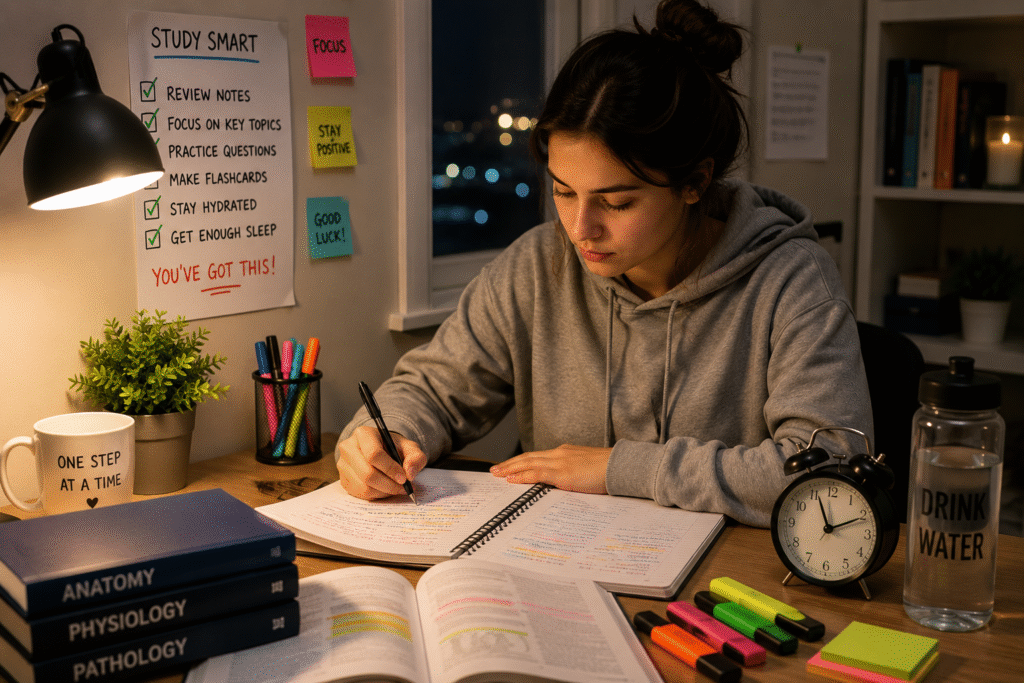
You just realized your test is tomorrow. The panic sets in, your notes feel like a foreign language, and you have no idea where to start. This happens to more students than you think, and the good news is that the night before a test can actually be used well, if you know what to do with it.
This guide covers exactly what to focus on, what to skip, and how to leave that study session feeling ready rather than defeated.
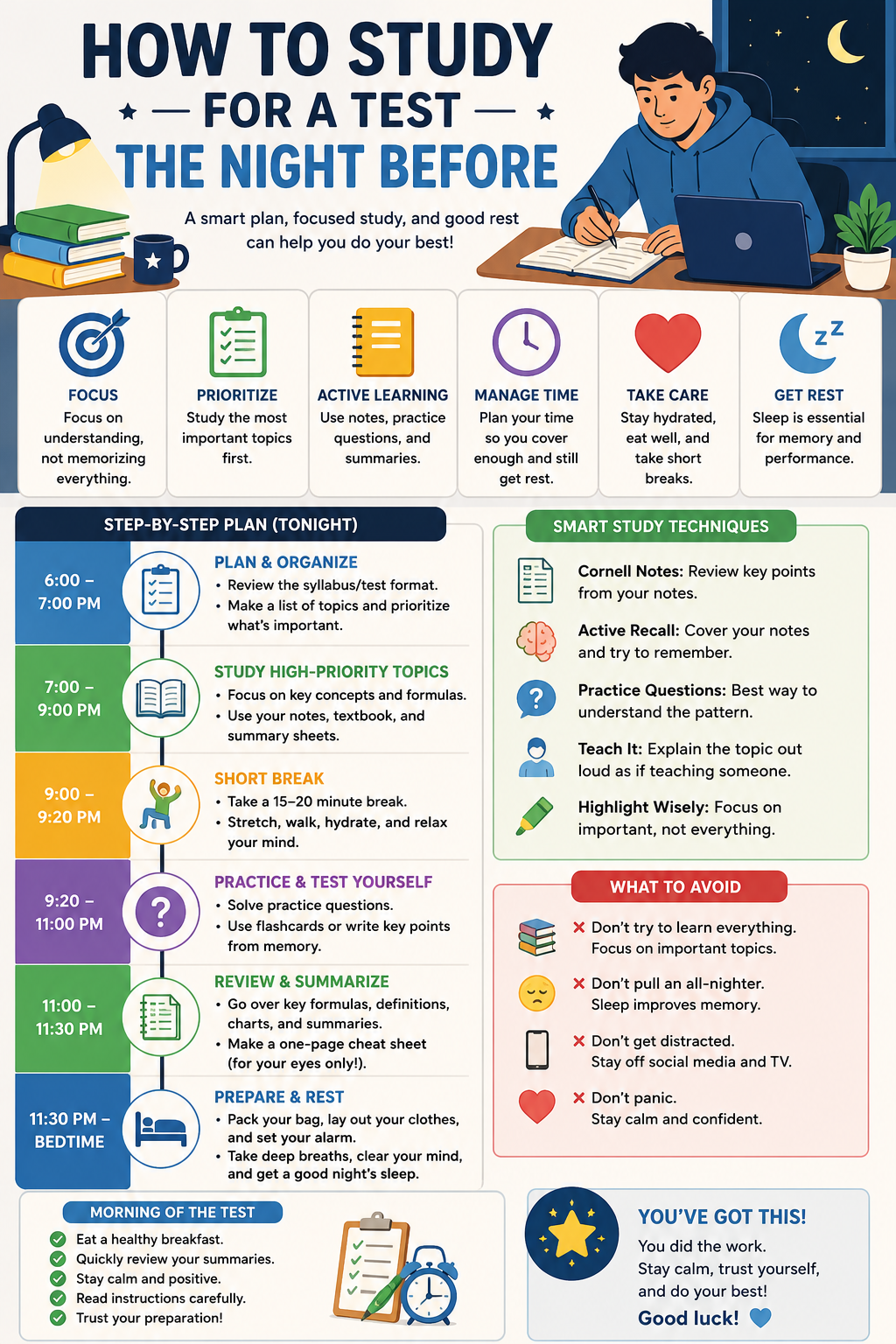
Set a time limit before you open a single book
The first mistake students make the night before is sitting down with zero structure. They flip through notes for three hours, absorb almost nothing, and go to bed exhausted. Before you do anything else, decide you are studying for 90 minutes maximum, then stopping.
Your brain retains information better in focused short bursts than in long, foggy marathons. Set a timer. When it goes off, you are done with active studying. This one decision changes how productive the entire session is.
Find out exactly what is on the test
This sounds obvious, but many students skip it. Pull up the syllabus, check your teacher’s notes, look at any study guide you were given, and read back through any emails or class announcements. You are not studying everything tonight. You are identifying the 20 percent of material most likely to appear on the test and putting all your attention there.
If you took notes in class and some topics came up repeatedly, those are almost certainly showing up tomorrow. If your teacher mentioned something twice, that is a signal. Make a quick list of the five to eight most important topics and work through those only.
Use active recall instead of rereading
Rereading your notes feels like studying but it is one of the least effective ways to actually retain information. Your brain gets comfortable recognizing words on a page without actually being able to recall them independently.
Active recall works differently. You cover your notes, try to write down or say out loud everything you remember about a topic, then check what you missed. Even doing this once with a topic locks it in far more reliably than reading the same paragraph four times.
A quick way to do this the night before a test is to take a blank piece of paper, write the topic at the top, and brain dump everything you know. What you cannot write down is exactly what you need to review. This targets your study time with precision instead of covering ground you already know.
Do practice questions, not just note review
If your teacher gave you a practice test, a review worksheet, or if your textbook has end-of-chapter questions, work through those before you do anything else. Testing yourself on the actual format of tomorrow’s exam does two things at once. It tells you which areas you know and which ones you are guessing on, and it gets your brain used to retrieving information the way it will need to tomorrow morning.
Students who understand how to improve test scores consistently report that practice questions the night before outperform rereading notes by a significant margin. You can see the evidence of this in how letter grades shift between students who test themselves versus those who simply review material passively.
If you are trying to understand what grade you need to pass, tools like the ones on our grade scale page can help you quickly calculate where you stand and what score you need tomorrow.
Do not try to learn completely new material tonight
If there is a topic you never understood in class, the night before the test is not the time to master it. Trying to learn something from scratch in a few hours creates confusion and crowds out the information you already know reasonably well.
Instead, acknowledge what you do not know and make a decision. Either you accept that topic as a likely miss and focus your energy on securing the points you can actually get, or you spend 15 minutes getting a basic surface understanding so you can attempt the question without leaving it blank. Surface knowledge on an unfamiliar topic is enough to earn partial credit in many cases, and partial credit beats a zero.
Write a short summary of each topic in your own words
After you have gone through active recall and practice questions, spend 10 minutes writing one to three sentences per major topic in your own words. This is different from copying notes. You are synthesizing what you know into a simple statement that a younger student could understand.
This technique, sometimes called the Feynman method, is particularly effective the night before because it forces your brain to identify gaps in understanding. If you cannot explain something simply, you do not know it well enough. Writing it down also gives you something to glance at briefly the morning of the test without needing to re-read pages of notes.
Sleep actually matters more than one more hour of studying
Most students underestimate this. After a certain point, staying awake to study is actively counterproductive. Sleep is when your brain consolidates what you studied into long-term memory. Cutting it short by two hours to squeeze in more reading means the material you covered earlier in the evening is less likely to stick by morning.
Aim for at least seven hours. If your test is at 8 AM and you need to wake up at 6:30, that means lights out by 11:30 at the latest. Work your study session backwards from that deadline, not forwards from when the panic started.
The morning of the test
Do not open new material the morning of the test. Glance at the short summaries you wrote the night before, eat something that is not just caffeine and sugar, and give yourself a few minutes of calm before walking in.
If you want to see how tonight’s effort might actually move your grade, it helps to understand the math. A student sitting at a 15/20 grade going into a test needs different preparation than someone starting at a 12/20 grade. Knowing your current standing changes what score you need to aim for tomorrow, which changes where you focus tonight.
What to do when you have more than one test coming up
If tomorrow’s test is one of several, do not try to study for all of them tonight. Pick the one that is worth the most, the one you are weakest on, or the one with the earliest deadline and give it your full 90-minute session. Splitting your attention between two subjects in a single cramming session produces worse results than going deep on one.
For students managing multiple assessments and trying to track their overall GPA impact, understanding how individual test scores feed into a cumulative grade is worth thinking about. A strong score on a 25-point quiz, for example, functions differently in your overall average than the same score on a 30-point test. If you have ever wondered how scores like a 22/25 grade or a 23/25 grade affect your standing, running the numbers before your test can sharpen your motivation for tonight.
If you only have 30 minutes
Thirty minutes is enough to do something useful if you use it correctly. Do not reread. Do not flip through everything. Pick the three topics most likely to appear, do one round of active recall on each, and write your three-sentence summaries. Then close everything and go to sleep. Thirty focused minutes beats two hours of anxious skimming every time.
What most students get wrong about last-minute studying
The biggest mistake is treating the night before as a time to learn. It is not. The night before a test is a time to organize and retrieve what you already know. Everything you covered in class over the past few weeks is in your memory somewhere. The job tonight is to make it accessible tomorrow morning, not to build new knowledge from scratch.
Students who understand this stop wasting time on material they have never seen and start using the time to strengthen what is already there. That mental shift, more than any specific technique, is what separates students who walk out of tests feeling okay from those who walk out relieved they guessed their way through.
If you want to know what passing looks like at your school level or in your state, our guide on what is a passing grade in high school breaks it down clearly. And if after your test you want to calculate exactly what you scored, whether that is a 24/30 grade, a 19/20 grade, or something in between, our grade tools give you the answer in seconds without doing the math yourself.