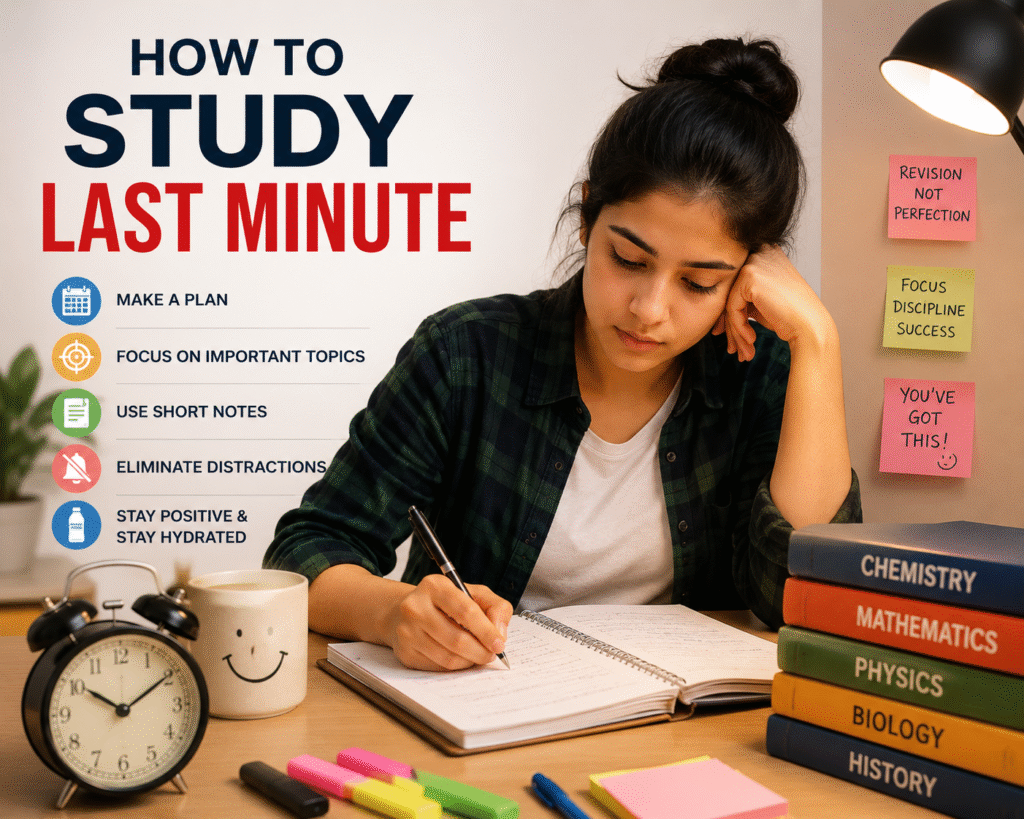
You have less time than you wanted and more material than you can cover. That gap between what needs to happen and the time available to make it happen is where most students make bad decisions. They try to read everything, panic when they cannot, and walk into the test having absorbed almost nothing.
Last-minute studying is not ideal, but it is also not useless. Students who treat the limited time strategically consistently do better than those who treat it as a lost cause. The difference is not intelligence or even work ethic. It is knowing what to do first and what to skip entirely.
Stop the first instinct, which is to reread everything
The moment most students sit down to cram, they open their notes from the beginning and start reading. This feels productive because it looks like covering material. It is not. Rereading is one of the weakest methods for actually retrieving information under pressure because your brain recognizes words on a page without being able to reproduce them independently.
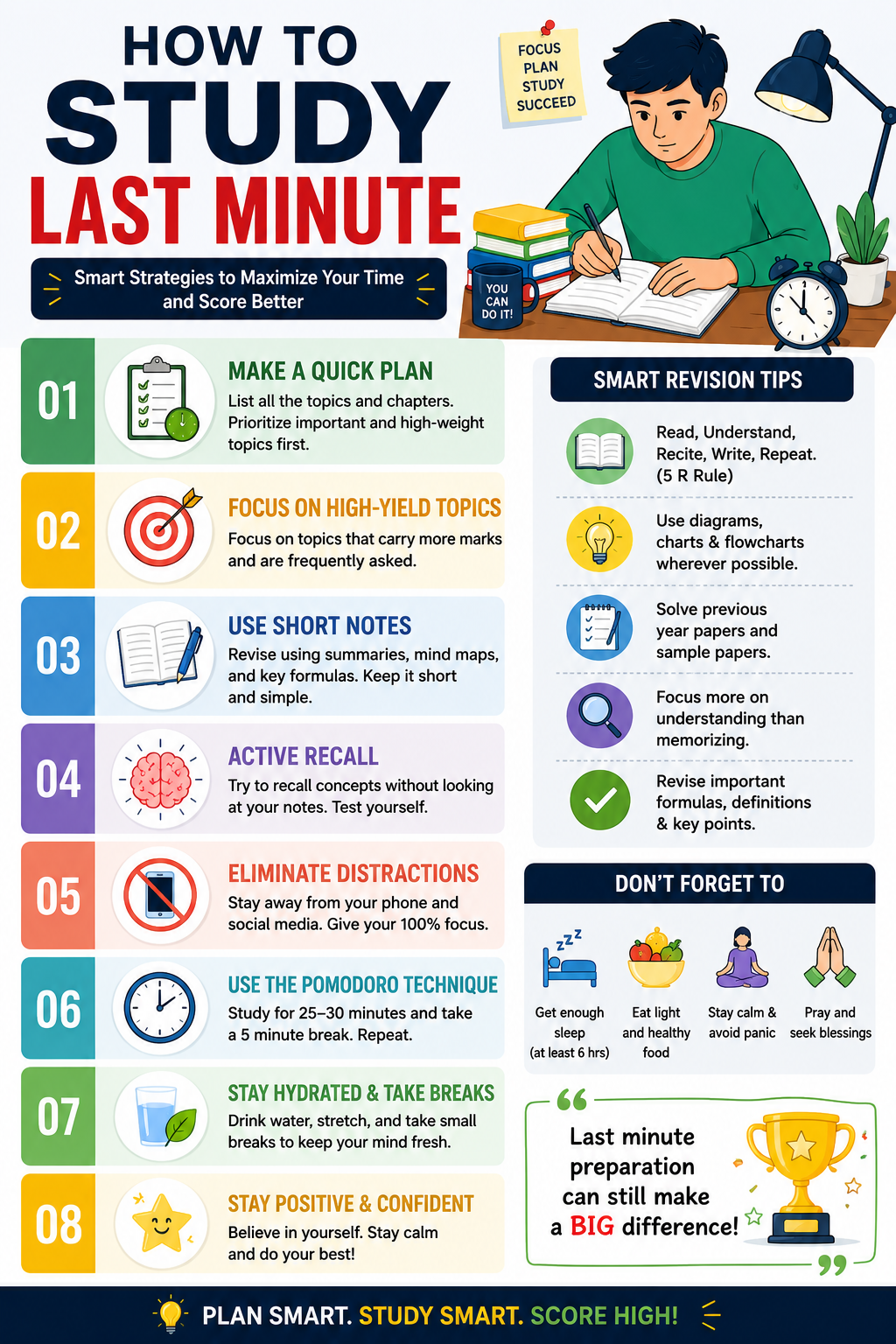
When time is short, recognition is useless. You need retrieval. Close your notes, pick a topic, and try to write down or say out loud everything you know about it right now, before looking anything up. What you cannot produce on your own is the only thing worth studying. Everything else you already know well enough.
Sort your material into three groups before studying any of it
This step takes five minutes and saves you from wasting the rest of your time on the wrong things. Go through your topics or chapters and sort them into three groups.
The first group is material you know reasonably well. You can explain it without looking at notes. Leave this alone tonight unless you finish everything else. The second group is material you have seen but cannot quite articulate clearly. This is where your time goes. You are not learning it from scratch, you are solidifying something that is already partly there. The third group is material you genuinely have no memory of and would need to start completely from zero. If the test is tomorrow and you have two hours, this group gets 15 minutes maximum or nothing at all.
Most students spend the majority of their cramming time on group three because it feels urgent. It is the wrong call. You will make far more gains strengthening group two than you will trying to build something from nothing in an hour.
Use time blocks, not open-ended sessions
When there is no structure to a last-minute study session, time disappears. Students look up and realize 45 minutes passed while they were staring at the same two pages. Set a timer for 25 minutes per topic from your group two list. When the timer goes off, spend three minutes writing a brief summary of what you just reviewed. Then move on regardless of whether you feel finished.
Moving on is the part students resist. They want to feel fully confident about one topic before touching the next. That feeling of confidence rarely arrives under time pressure anyway, and waiting for it means some topics never get touched. A surface review of five topics serves you better than a deep review of two.
The two questions that tell you what to study first
If you have multiple topics to cover and genuinely do not know where to start, ask yourself two things. First, which of these topics has the highest chance of appearing on the test? Second, which one would cost me the most points if I left it blank?
The answer to the first question usually comes from what your teacher emphasized most in class, what appeared on previous quizzes, or what the study guide or syllabus put at the top. The answer to the second question comes from understanding how your grade is structured. A topic worth 20 points of a test deserves more of your time tonight than a topic worth five. If you are not sure how different scores would affect your overall grade, checking what you currently sit at on the grade scale helps clarify exactly what tomorrow’s test needs to do for you.
Say it out loud instead of reading it silently
This sounds strange but it works consistently. When you read study material silently, your eyes move across words while your brain runs on autopilot. When you say the material out loud, your brain has to process and produce the information rather than simply recognize it. You are also using an additional sensory channel, which creates a stronger memory trace.
You do not need to be dramatic about it. Just talk through the topic like you are explaining it to someone sitting next to you. Pause when you get stuck. Fill in the gap by glancing at your notes. Then try the explanation again. Students who do this even once with a difficult concept remember it more reliably than students who read it five times.
What to do with formulas, dates, and definitions
Factual recall items like formulas, historical dates, and vocabulary definitions respond well to a simple flashcard approach even if you are making the cards on sticky notes or scraps of paper right now. Write the term or formula on one side, the definition or answer on the other. Go through the stack once. Pull out anything you get wrong. Go through the wrong ones again. Keep narrowing the pile until you are only reviewing the ones you genuinely cannot recall.
This works under time pressure because it is self-correcting. You spend no time on things you already know and all your remaining time on the gaps. The stack shrinks as you learn, which also feels motivating when the clock is working against you.
Partial knowledge earns partial credit
One thing students forget when cramming is that walking into a test with incomplete knowledge is not the same as walking in with no knowledge. On most tests, partial credit exists for showing your reasoning, defining part of a term correctly, or demonstrating you understand the general concept even if you cannot recall the specific detail.
This matters because it changes how you approach group three material. Rather than ignoring it entirely, spend a few minutes getting a general surface understanding of any topic you genuinely know nothing about. If a question on it appears tomorrow, writing something coherent earns you more than leaving it blank. A student sitting at a 17/25 grade going into a test knows they can afford to miss some points. A student at a 12/20 grade heading into a higher-stakes assessment needs every point available, which changes how much risk to take on group three material.
The most effective 60-minute last-minute plan
If you have exactly one hour before you need to stop and sleep, here is how to use it without wasting any of it.
Spend the first ten minutes sorting your topics into the three groups described earlier. Do not study anything during this time. Just sort and prioritize.
Spend the next 40 minutes on active recall for your group two topics. Cover your notes. Try to explain each topic out loud. Check what you missed. Move on when the timer signals.
Spend the final ten minutes writing one sentence per topic summarizing the most important thing about it. These sentences are what you glance at in the morning, not your full notes.
Then stop. More time does not always mean better results when the session has no structure and your brain is tired.
Why sleep is not optional even during last-minute prep
This comes up in every study guide and students ignore it every time, so it is worth being direct about. When you sleep, your brain consolidates what you reviewed during the session into retrievable memory. When you stay awake instead, two things happen. The consolidation does not occur, meaning the material you studied becomes harder to access the next morning. And your cognitive performance drops the next day, meaning you make more avoidable mistakes on questions you actually know.
Cutting one hour of sleep to study one more hour of material almost always produces worse results than sleeping. The exception is if you have studied nothing at all and have two hours of time, in which case a focused session followed by a full night of sleep is better than nothing. But staying up past the point where you are genuinely absorbing information is not studying. It is anxiety with a textbook open.
After the test, track what actually happened
One thing students rarely do after a last-minute session is connect the effort to the outcome. After you get your result back, check whether the topics you prioritized appeared on the test and whether the material you skipped cost you points. This feedback loop makes the next last-minute session faster and more targeted, because you start to understand your own patterns for what matters most in each class.
If your grade lands somewhere like a 22/25 or a 23/25, you know your last-minute approach worked and which parts of it to repeat. If it lands closer to an 11/15 grade or a 13/16 grade, the gap tells you something specific about where your preparation broke down, which is information you can actually use next time.
For students who want to understand what their scores mean for their overall standing, whether they need to pass a certain threshold or improve before finals, our guide to what is a passing grade in high school and the grade scale calculator give you the numbers without any guesswork.
Frequently Asked Questions
Q1: Is it actually possible to pass an exam by studying the night before?
A: Yes, but it depends on your strategy. You cannot learn a whole semester’s worth of deep concepts in 8 hours, but you can pass by focusing strictly on high-yield topics. Instead of reading everything, target main themes, lecture summaries, and past exam questions to capture the most heavily weighted material.
Q2: Should I pull an all-nighter to get more study time?
A: Generally, no. Sleep deprivation severely damages your brain’s ability to recall information and focus during the test. It is highly recommended to get at least 4 to 5 hours of sleep. If you must stay up late, stop studying 30 minutes before bed to let your brain transition into sleep mode so your memory can consolidate.
Q3: What is the fastest study method when I only have a few hours?
A: Skip passive reading and use Active Recall and the Feynman Technique:
-
Feynman Technique: Quickly explain a concept out loud to an imaginary 5-year-old. If you stumble, you don’t know it.
-
Blurt Method: Read a summary sheet for 5 minutes, close it, and write down everything you remember on a blank sheet in red pen. Then, check what you missed.
Q4: How do I decide what to study and what to skip?
A: Use the 80/20 Rule (Pareto Principle): 80% of the exam points usually come from 20% of the core concepts.
-
Skip: In-depth textbook chapters and minor details.
-
Focus on: Lecture slides (especially summary slides), bolded terms, review sheets, and any topics the teacher repeatedly emphasized in class.
Q5: How can I stop panicking so I can actually focus?
A: Panic triggers a fight-or-flight response, which shuts down your working memory.
-
Take 3 deep breaths (inhale for 4 seconds, hold for 4, exhale for 4).
-
Put your phone in another room or turn on “Do Not Disturb.”
-
Accept that you can’t learn everything, choose 3 key topics to master right now, and start immediately. Action cures anxiety!