
Being in the top 1% of your class is a remarkable academic achievement. Students who reach this level consistently earn outstanding grades, perform well on exams, and often take challenging courses. However, many students wonder, what GPA is top 1%, and whether there is a universal GPA requirement.
The answer depends on your school, grading scale, and the academic performance of your classmates. In this guide, we’ll explain the GPA typically associated with the top 1%, factors that influence class rankings, and what you can do to reach this elite academic level.
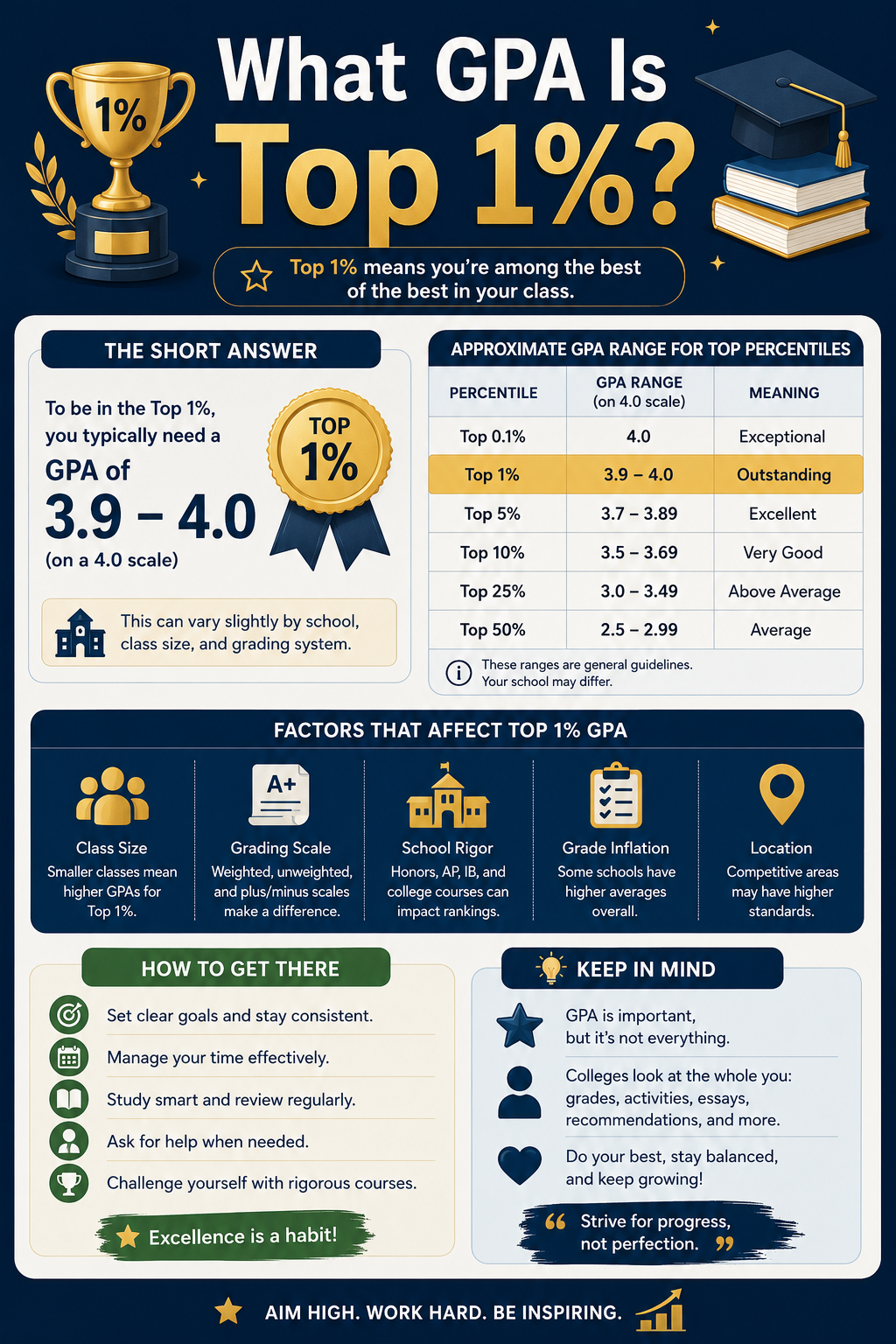
What GPA Is Typically Required for the Top 1%?
There is no single GPA that guarantees a top 1% class ranking because every school calculates GPA and class rank differently.
In many U.S. high schools, students in the top 1% often have:
| GPA Scale | Typical Top 1% GPA |
|---|---|
| 4.0 Unweighted | 3.95–4.00 |
| 5.0 Weighted | 4.5–5.0 |
Some highly competitive schools may require a perfect GPA along with multiple Advanced Placement (AP), International Baccalaureate (IB), or honors courses to earn a top 1% ranking.
Why There Isn’t a Universal GPA for the Top 1%
Every school uses its own grading policies and ranking methods. Factors that affect the GPA needed for the top 1% include:
- Whether the school uses a weighted or unweighted GPA.
- The number of honors, AP, or IB courses available.
- The academic performance of other students.
- How class rank is calculated.
Because of these differences, a GPA that places you in the top 1% at one school may not achieve the same ranking at another.
Not necessarily.
At some schools, many students earn a 4.0 unweighted GPA. In these cases, class rank is often determined by:
- Weighted GPA
- Number of advanced courses completed
- Overall course difficulty
- Additional academic achievements
This means two students may both have a 4.0 GPA, but one may rank higher because they completed more rigorous coursework.
How Can You Reach the Top 1%?
Achieving a top 1% ranking requires consistency throughout high school.
Here are several strategies that can help:
- Maintain high grades in every subject.
- Take AP, IB, or honors classes when available.
- Complete assignments on time.
- Prepare thoroughly for exams.
- Ask for help when you struggle with a topic.
- Develop strong study habits.
- Stay organized throughout the school year.
Small improvements made consistently over several years can significantly impact your final GPA.
Does the Top 1% Help With College Admissions?
Yes. Being in the top 1% of your class can strengthen your college applications.
Many universities value applicants who demonstrate:
- Excellent academic performance.
- Strong class rankings.
- Challenging coursework.
- Consistent improvement.
- Good time-management skills.
However, colleges also consider extracurricular activities, leadership, essays, recommendation letters, and standardized test scores where applicable.
GPA vs. Class Rank
Although they are related, GPA and class rank are not the same.
| GPA | Class Rank |
|---|---|
| Measures your academic performance. | Compares your performance with classmates. |
| Based on your grades. | Based on everyone’s GPA in your class. |
| May remain the same even if your rank changes. | Changes as classmates’ GPAs change. |
A high GPA improves your chances of ranking in the top 1%, but your classmates’ performance also plays a role.
How Percentages Relate to Letter Grades?
If you’re trying to improve your GPA, understanding how grades convert into percentages is a great place to start. Our Grade Scale guide explains how percentages relate to letter grades.
You may also find these related resources helpful:
Frequently Asked Questions
What GPA is considered top 1%?
In many schools, students in the top 1% typically have an unweighted GPA between 3.95 and 4.0 or a weighted GPA above 4.5, although this varies by school.
Is a 4.0 GPA always top 1%?
No. At competitive schools, many students earn a 4.0 GPA, so weighted GPA and course difficulty often determine the final class rankings.
Can a 3.9 GPA be top 1%?
Yes, at some schools a 3.9 GPA may be enough to rank in the top 1%, while at others it may not. It depends on your school’s grading system and your classmates’ performance.
Does taking AP classes help my class rank?
Yes. AP, IB, and honors classes usually increase your weighted GPA, which can improve your class ranking.
Is class rank more important than GPA?
Both are important. GPA reflects your academic performance, while class rank shows how you compare with other students in your graduating class.
Do colleges prefer students in the top 1%?
Many competitive colleges value students in the top 1%, but admissions decisions also consider essays, extracurricular activities, leadership, recommendation letters, and other achievements.
Final Thoughts
There is no universal GPA required to rank in the top 1% because every school uses its own grading system and class-ranking policy. In general, students who achieve this distinction maintain exceptional grades, take rigorous coursework, and consistently perform at a high academic level. If your goal is to reach the top 1%, focus on earning strong grades, challenging yourself with advanced classes, and developing effective study habits throughout your academic journey.